



Learn what to expect after surgery, which care measures are important during healing, and the steps usually recommended for a gradual return to sexual activity after the Egydio Technique.
The decision to surgically treat Peyronie’s disease may represent a therapeutic alternative for men experiencing frustration, insecurity, or sexual limitations associated with the condition. However, surgery is only the first step in a longer therapeutic process.
Postoperative recovery depends, in part, on an adequate healing period, since it is during recovery that the work performed by the surgeon in the operating room becomes consolidated, allowing the tissues to heal in an aligned and functional way.
During the postoperative period of Peyronie’s disease, the partnership between doctor and patient continues: the urologist must follow the patient closely, while the patient must comply with medical guidance in order to support proper recovery and a gradual return to sexual activity, according to each patient’s clinical progress.
In this guide, understand the main stages of recovery, post-surgical care after Peyronie’s surgery, and the return to sexual activity.
The First 48 Hours: Comfort Management and Local Care
The first 48 hours after surgery are an essential period for the beginning of healing after penile surgery and for adequate discomfort control.
Hygiene and dressing care
The patient should clean the operated area carefully, following the medical team’s instructions. Therefore, he may wash the penis with warm water and mild soap, avoiding direct friction over the incision.
After washing, the patient should dry the area gently with a clean towel or sterile gauze, without rubbing. Keeping the incision dry helps prevent infections and supports the healing process.
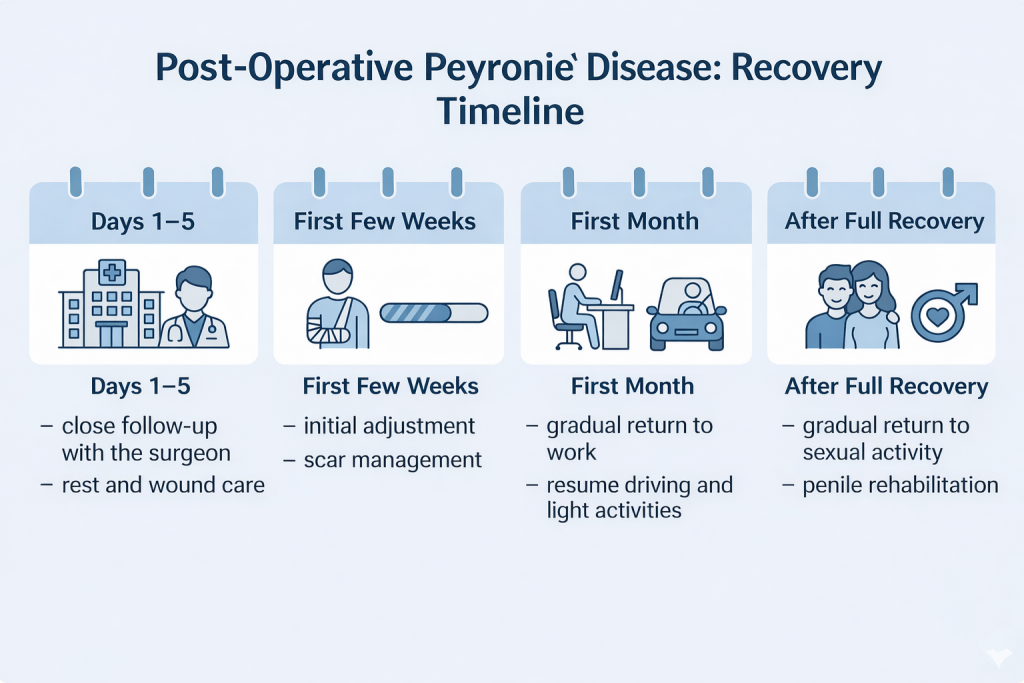
The patient should keep the dressing in place during the first five days, without the need for replacement, in order to protect the wound and help reduce edema (swelling). After this period, the patient should change the dressing daily for another five days, according to medical instructions.
Pain control and medication use
Some degree of discomfort is expected in the first few days, but the patient usually manages it well with the prescribed medication.
It is essential to strictly follow the antibiotic and pain relief schedule indicated by the doctor. Antibiotics help prevent infections in the surgical wound, while pain medications provide greater comfort during recovery.
The patient should avoid self-medication. If there are questions about the medication, clarification should be sought from the medical team.
Rest
The patient should maintain relative rest during the first few days after surgery. The recommendation is to avoid intense physical effort, such as lifting weights, engaging in vigorous exercise, or carrying out activities that increase pressure in the abdominal and pelvic region.
If there is an urgent question about the surgical dressing or in case of excessive discomfort, the patient may contact the nursing team for quick clarification via WhatsApp.
Penile Rehabilitation Protocol and Active Physiotherapy
After the initial healing phase, another equally important stage begins: postoperative penile rehabilitation. This process aims to preserve the dimensions achieved in the procedure, when applicable, support healing, and help restore erectile function.
When to begin rehabilitation exercises
Penile physiotherapy exercises should not be started too early. It is necessary to wait a few weeks for the initial healing of the tunica albuginea to become established.
The exact time to begin any rehabilitation technique will be determined by the urologist during follow-up appointments. However, the doctor will explain to the patient how to correctly perform penile physiotherapy and what precautions are necessary during manipulation of the penis, in order to avoid excessive mechanical stress on the healing tissues.
The role of penile traction therapy
Penile traction therapy may be an important technique in the postoperative period of Peyronie’s disease. Its goal is to prevent scar retraction and help preserve the maximum length achieved during surgery.
This method uses specific devices or manual maneuvers that apply gentle and progressive traction to the penis.
The doctor will demonstrate the correct way to carry out this therapy, explaining the appropriate intensity, duration, and frequency. Incorrect performance may interfere with postoperative recovery and should therefore be avoided.
Medications that support tissue oxygenation
Some rehabilitation protocols include the use of phosphodiesterase type 5 (PDE5) inhibitors, such as Sildenafil or Tadalafil.
These medications are widely known for their role in the treatment of erectile dysfunction, since they promote vasodilation and improve blood flow in the penile corpora cavernosa. In the postoperative period of Peyronie’s disease, they may support tissue oxygenation during healing in some cases.
These medications should always be prescribed by the doctor. The patient should follow the prescribed dose and schedule in order to maintain treatment safety and the effectiveness of the rehabilitation protocol.
Return to Sexual Activity: The Recovery Timeline
One of the most common questions during recovery from penile curvature surgery is related to the safe time to resume sexual activity, which only occurs in the final stage of the postoperative period.
The 45-to-60-day barrier
In most cases, a period of sexual abstinence between 45 and 60 days is recommended.
This interval allows the more superficial tissues to heal properly and the repaired areas of the tunica albuginea to integrate in a stable way.
Resuming sexual activity too early may compromise this process and affect the surgical outcome.
The first sexual intercourse after surgery
The return to sexual activity should be cautious.
Before the first sexual intercourse, during postoperative follow-up, the doctor will already have explained to the patient how the penile prosthesis works and the guidance for its correct use, with the aim of providing greater safety at this moment.
The use of lubricants may be recommended at this stage to help reduce friction in the operated area.
Sensitivity management and expectations
Maintaining realistic expectations during this phase is important for a smoother recovery.
Schedule your postoperative follow-up appointment to closely monitor recovery and find out when it is appropriate to resume sexual activity after surgical treatment for Peyronie’s disease.
Particularities of the postoperative period after the Egydio Technique
The Egydio Technique corresponds to a surgical approach used in the treatment of Peyronie’s disease, with specific characteristics also in the postoperative context.
Minimizing penile shortening
The fundamental principle of the technique is tissue expansion based on geometric concepts.
Rather than only correcting the curvature, the method aims to restore penile length through controlled tissue expansion. This may help recover lost size up to the limit of the nerves and avoid penile shortening associated with other surgical techniques, such as plication.
Recovery at home
Recovery after the procedure takes place at home. Depending on the technique used and the characteristics of the case, recovery may occur at home, and the patient does not require continuous care, although postoperative discomfort of varying intensity may occur and is generally controlled with prescribed medication.
Specialized follow-up in Portugal
Postoperative follow-up for Peyronie’s disease is carried out in Portugal, where Dr. Paulo Egydio provides clinical follow-up.
During the recovery period, the patient may attend appointments, adjust the penile rehabilitation protocol, and clarify doubts in person, allowing continuity of clinical follow-up throughout the recovery process.
The importance of adherence to the rehabilitation plan
Peyronie’s surgery is an important step in restoring penile anatomy, but the final outcome depends directly on how the recovery period is managed.
Measures such as following medical guidance, respecting healing times, and complying with the penile rehabilitation protocol may contribute to a more organized postoperative recovery, while respecting healing and the therapeutic plan defined by the doctor.
Do you have questions about your recovery process or would you like an assessment of your progress? Schedule your appointment for follow-up with Dr. Paulo Egydio’s team in Portugal.