


The use of medications after penile prosthesis placement may be necessary in cases of corpus cavernosum impairment before surgery or in situations involving severe vascular problems.
A penile prosthesis is indicated when vasodilator medications for erectile dysfunction do not produce satisfactory results. However, these medications may still be recommended by the urologist even after the surgical procedure.
In some cases, the use of vasodilators such as tadalafil after penile prosthesis placement may be necessary, especially if the corpora cavernosa were compromised due to fibrosis or severe vascular problems.
Learn more about the relationship between medication and penile prosthesis.
What to expect after penile prosthesis surgery
The penile prosthesis is intended to restore penile function, with the goal of restoring penile rigidity adequate for penetration and contributing to sexual quality of life.
By restoring penetrative capacity, some patients report improved self-esteem and confidence, associated with the recovery of erectile function, which may be reflected in intimate life.
Can someone with a penile prosthesis take tadalafil?
Yes, a man may take tadalafil after penile implant surgery, as well as other vasodilator medications, as long as they are prescribed by the urologist.
Medication and penile prosthesis: when are they needed together?
How medications help with recovery and adaptation
The use of medications in the postoperative period after penile prosthesis surgery, such as low-dose tadalafil, may help with adaptation to the penile prosthesis. However, the medication requires prescription and follow-up by a urologist. Among the possible effects associated with the use of medication, when indicated by the doctor, are:
- Improved blood flow;
- Oxygenation of the corpora cavernosa;
- Maintenance of glans volume and sensitivity;
- Improved healing of penile tissue.
When it is necessary to adjust or discontinue medication use
There are situations in which the urologist may adjust the dose or suspend the use of medications in patients with a penile prosthesis:
- Presence of medication side effects;
- When vascularization and adaptation to the prosthesis are already satisfactory;
- Diagnosis of cardiovascular disease.
What is the role of the corpora cavernosa in prosthesis outcomes?
Preserving the corpora cavernosa during penile prosthesis surgery is important for maintaining local oxygenation, the natural appearance of the penis, and sensations in the glans when it fills with blood during sexual arousal.
For this reason, the integrity of the cavernous tissue favors vascularization and glans sensitivity after prosthesis placement.
The importance of proper penile prosthesis sizing
Proper prosthesis sizing influences the need for medication use after surgery.
When the implant is adjusted to the length and thickness of the penis, there is a better fit in the corpora cavernosa. This also helps preserve vascularization and favors penile function after prosthesis placement.
Thus, proper sizing may reduce the need for medication use in some cases.
Why the surgeon’s experience impacts the need for medication
Clinical and surgical experience allows the professional to choose the most suitable prosthesis, taking into account the relationship between penile length and thickness, in order to preserve vascular structures as much as possible and avoid prosthesis displacement or tissue perforation.
An appropriate surgical approach, based on the individual evaluation of the case, may influence the need for complementary therapy in the postoperative period.
Precautions when using medication after prosthesis placement
The use of any medication after surgery requires important precautions so as not to compromise recovery. It is essential to follow these guidelines:
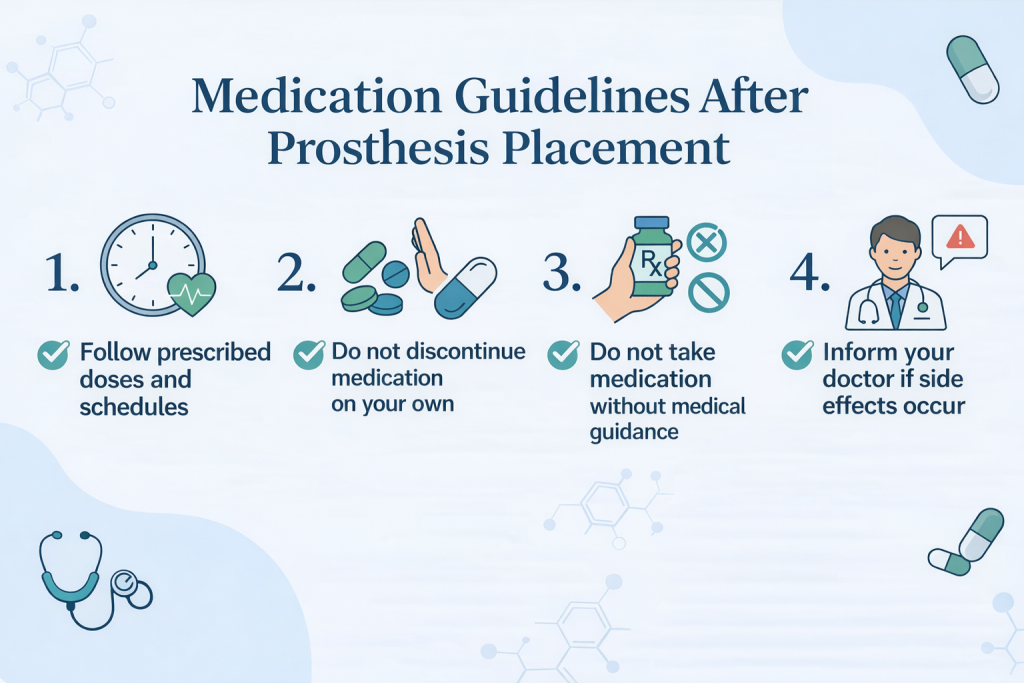
The importance of ongoing medical follow-up
Medical follow-up after penile prosthesis surgery is essential for patient safety and long-term treatment outcomes. During follow-up, the urologist performs the following actions:
- Monitors healing;
- Detects possible complications;
- Evaluates prosthesis function and provides handling guidance, especially in the case of inflatable prostheses;
- Adjusts medication if necessary;
- Provides guidance on returning to activities, including sexual activity.