


Understand the role of hemodynamic mapping in the evaluation of penile reconstruction in Portugal and its usefulness in therapeutic planning.
The presence of penile curvature may cause concern, especially when it appears together with pain or difficulty during sexual activity.
This concern is often experienced in silence. In addition, it is common for men to delay seeking medical help, which prolongs suffering and may worsen the clinical condition.
In the face of these difficulties, evaluation by a urologist with experience in the management of penile curvature may help frame the diagnosis and therapeutic options.
Through penile assessment exams, including Eco-Doppler when indicated, it is possible to complement the diagnostic investigation of Peyronie’s disease and support the definition of the most appropriate therapeutic approach for each case.
What is Dynamic Penile Eco-Doppler and why is it indispensable?
Dynamic Penile Eco-Doppler is an imaging exam that evaluates the anatomical structure and blood circulation of the penis.
The exam makes it possible to assess relevant hemodynamic parameters in the context of Peyronie’s disease and erectile dysfunction, and it may contribute to the characterization of the clinical condition and to therapeutic guidance.
In addition, it provides information for the surgical planning of penile reconstruction in cases where surgery is indicated.
The difference between standard ultrasound and Dynamic Doppler
The main difference between standard ultrasound and Dynamic Doppler is that the former allows the analysis of structures inside the penis, while the latter also makes it possible to evaluate the penile vascular system. This distinction may be relevant in the diagnostic investigation and clinical characterization of cases associated with Peyronie’s disease and erectile dysfunction.
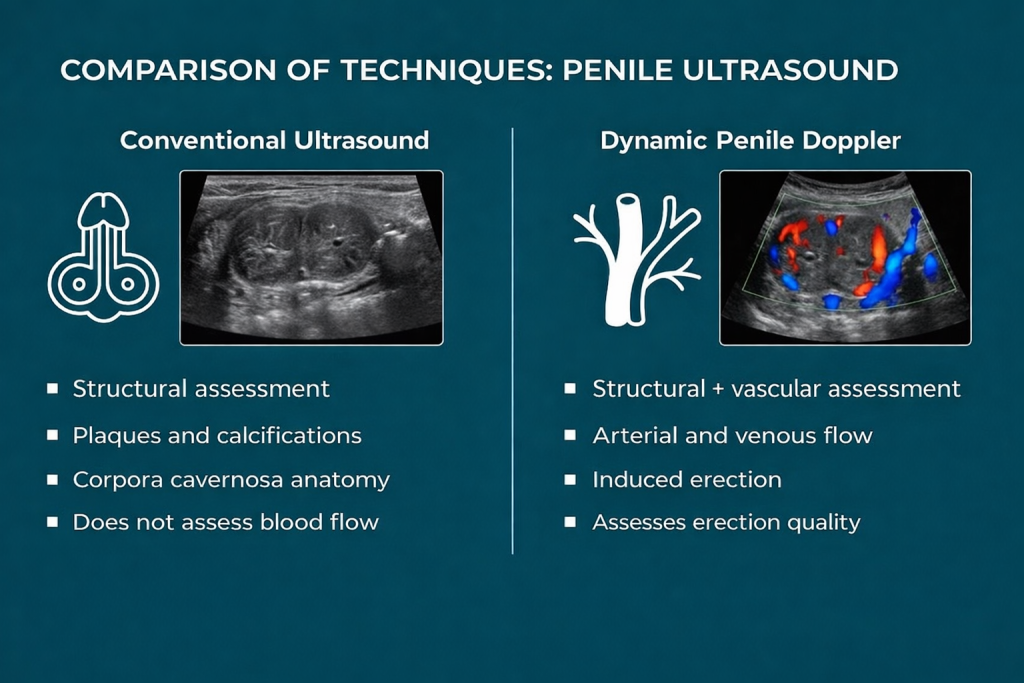
In conventional penile ultrasound, fibrotic plaques, calcifications, or structural alterations of the corpora cavernosa may be identified. Based on this evaluation, the urologist may estimate the degree and direction of the deformity and assess shortening, but this approach does not, by itself, allow a complete characterization of the functional component of erection.
Dynamic Penile Eco-Doppler, on the other hand, combines ultrasound imaging with the study of arterial and venous blood flow and is performed with the penis erect through pharmacological induction. This evaluation makes it possible to observe the curvature under functional conditions, measure the deformity more accurately, and analyze the vascular quality of the erection.
Dynamic Penile Eco-Doppler with pharmacological induction may facilitate the identification of fibrosis and calcified plaques, including situations in which these are not easily detectable on manual palpation. Its usefulness may be particularly relevant when plaques are deep, small, extensive, or located in less accessible areas.
When the exam is performed, it may be possible to characterize the location, extent, thickness, and possible calcification of plaques, contributing to a more detailed clinical evaluation and to the definition of the therapeutic strategy.
Assessment of blood flow and vascularization
Through Doppler technology, the urologist may evaluate penile blood flow and vascularization, including parameters such as blood flow velocity in the cavernosal arteries and the functioning of the venous occlusive mechanism. These elements are relevant in the assessment of erectile function.
The results may indicate arterial insufficiency, associated with difficulty in blood inflow, or venous leak, when the blood is not adequately retained, conditions frequently associated with erectile dysfunction.
How the Exam Guides the Egydio Technique in Portugal
Protection of sensitivity and nerve bundles
The information obtained in Dynamic Doppler may contribute to intraoperative planning and to the consideration of relevant neurovascular structures. This care is important in the context of functional and sensory preservation.
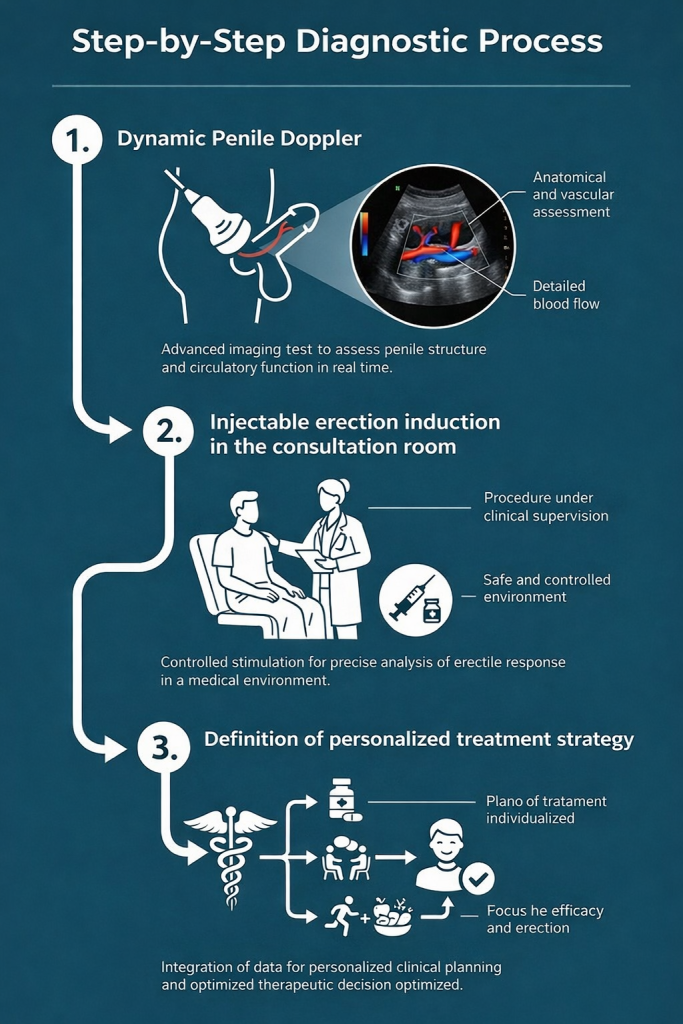
Dynamic Doppler is a simple exam and does not require specific preparation. The procedure takes place in an outpatient setting, with privacy, and has an average duration of 30 to 45 minutes. This time includes the period necessary for obtaining and monitoring the erection.
Pharmacological induction of erection is carried out through the administration of a vasoactive drug directly into the corpora cavernosa. The injection is generally brief and, in most cases, well tolerated, producing a pharmacologically induced erection for evaluation purposes.
After the anatomical and vascular assessment, the patient remains under observation until the erection subsides, reducing the risk of priapism.
Definition of the personalized surgical strategy
After evaluating the case, considering the results of Penile Doppler, the clinical complaints, and the other exams performed, including anamnesis, physical examination, and laboratory tests when indicated, the urologist may frame the most appropriate therapeutic options for each situation.
In mild to moderate cases, when there is no vascular compromise and the curvature does not significantly interfere with sexual intercourse, the physician may recommend conservative treatment. However, when there is loss of penile function, the indication may be surgical.
Why choose Dr. Paulo Egydio for your diagnosis in Portugal?
Dr. Paulo Egydio’s international experience is fully aligned with the Portuguese healthcare system, allowing him to practice in Portugal in the treatment of men with Peyronie’s disease and erectile dysfunction.
Specialist with active registration in the Portuguese Medical Association
Dr. Paulo Egydio is a urologist with active professional registration in the Portuguese Medical Association. His regular registration ensures patients strict compliance with the standards of medical practice in the country and the exercise of activity in accordance with ethical, scientific, and deontological standards.