


How to Treat Penile Fibrosis (or Peyronie’s Plaque)? Learn About the Treatments

Homem negro de dreads e piercings levando a mão direita a cabeça em estado pensativo.

How to Treat Penile Fibrosis (or Peyronie’s Plaque)? Learn About the Treatments

Homem negro de dreads e piercings levando a mão direita a cabeça em estado pensativo.
Assuntos

Understanding how to treat penile fibrosis is one of the main concerns among men diagnosed with plaques inside the penis, and it is an issue that requires individualized clinical evaluation.

Penile fibrosis, which may be associated with the deformities of Peyronie’s disease and, in some cases, erectile dysfunction, can cause discomfort during sexual activity and affect the patient’s quality of life.

Given these possible consequences, it is important to understand the therapeutic options available in Portugal for the treatment of penile plaques, always according to the clinical evaluation of each case.

See also: Peyronie’s Disease: Video on Surgical Treatment

How to Treat Penile Fibrosis?

A tailored approach to penile fibrosis depends on follow-up with a urologist in Portugal, who can analyze the case in detail based on the clinical evaluation and, when necessary, complementary diagnostic tests.

There are several treatment options for penile curvature, which may vary according to the characteristics of the fibrosis, the severity of symptoms, the functional impact of the disease, and the patient’s expectations.
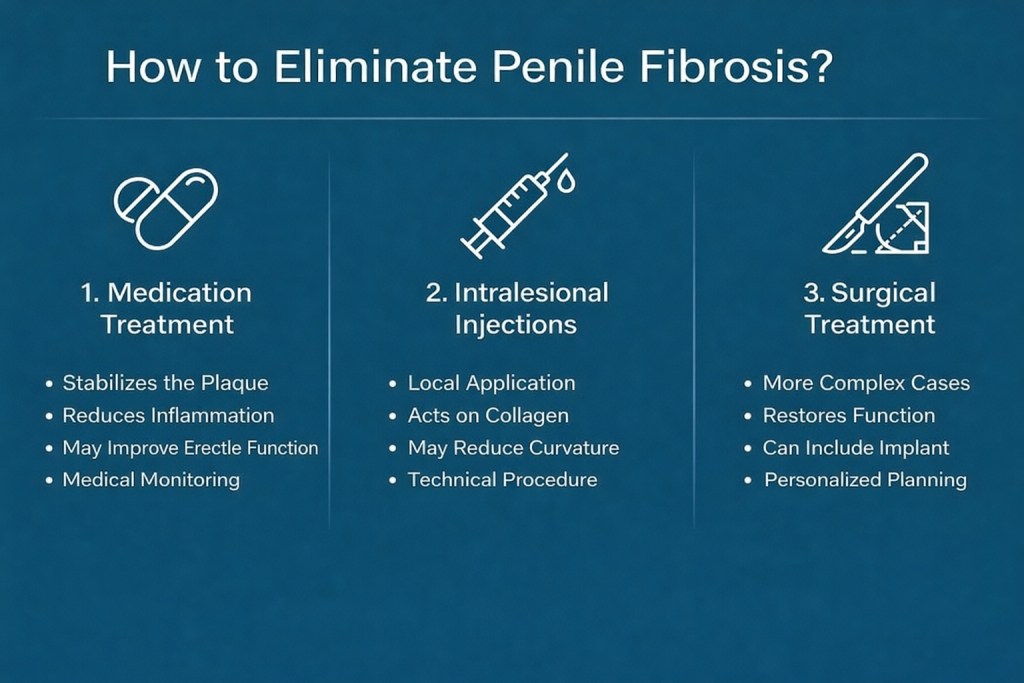
Infographic on a dark teal background titled “How to Treat Penile Fibrosis?”, organized into three vertical blocks with minimalist white icons. The first block presents “Medication-Based Treatment,” represented by a pill, highlighting plaque stabilization, inflammation control, and medical follow-up. The second block shows “Intra-plaque Injections,” with a syringe icon, indicating local application and action on collagen. The third block presents “Surgical Treatment,” with a scalpel icon, referring to more complex cases and recovery of function. Clean design with limited text and a comparative visual focus.

Medication-Based Treatment

Medication-based treatment may be considered in some cases, with the aim of controlling symptoms and guiding the therapeutic approach according to the stage and characteristics of the disease.

In some cases, the doctor may consider medication therapy according to the patient’s clinical situation, taking into account the stage of the disease, treatment goals, and the safety profile of each option.

When pain is present, the doctor may consider appropriate medication for symptom control, according to the clinical evaluation and the specific needs of the patient.

If erectile dysfunction is associated, the doctor may consider therapy aimed at improving erectile response, always after individualized evaluation and taking into account indications, contraindications, and possible adverse effects.

Medication-based treatment should always be followed by a urologist, who monitors the patient’s clinical response and reassesses the therapeutic strategy whenever necessary.

See also: Penile Prosthesis in Complex Peyronie’s Disease and Erectile Dysfunction

Injection Treatment

Another therapeutic possibility in selected cases is the use of intraplaque injections, whose indication should be assessed individually, taking into account the characteristics of the fibrotic plaque, the symptoms, and the clinical goals of treatment.

Because it is an invasive procedure, the doctor should explain in advance the potential benefits, limitations, and associated risks, including the possibility of pain, edema, or local hematoma.

Among the options described for intraplaque use are different medications, whose choice depends on the clinical evaluation and the therapeutic strategy defined for each case.

See also: Penile Implant Recovery: How to Manage Post-Surgical Pain

Surgical Treatment for Penile Fibrosis

Surgical treatment of Peyronie’s disease may be considered in selected cases, particularly when there is stable deformity with relevant functional impact and/or associated erectile dysfunction, after individualized clinical evaluation.

What Are the Different Surgical Techniques for Penile Fibrosis?

There are several surgical techniques described for the treatment of Peyronie’s disease, and none is universally indicated for all patients.

For this reason, surgical treatment of penile fibrosis should always be individualized, taking into account the degree of curvature, the presence of associated deformities, such as narrowing or “hourglass” deformity, and the state of erectile function.

Surgical interventions can be planned according to the pattern of the deformity and the functional goals of treatment, always taking into account the anatomical and clinical characteristics of each patient.

Among the available surgical approaches, there are reconstructive techniques that seek to act on the shortened side, respecting the patient’s anatomical and neurovascular limits when clinically indicated.

In these approaches, the surgeon may perform multiple controlled incisions, according to the pattern of the deformity, with the aim of correcting penile alignment and, when clinically possible, preserving or recovering dimensions affected by the disease.

The surgeon may also associate this procedure with the implantation of a penile prosthesis, especially when erectile dysfunction is present, with the aim of providing rigidity support compatible with sexual activity, according to the clinical evaluation.

See also: Peyronie’s Surgery Cost in Portugal: Is It Worth the Investment?

Physiotherapy for Penile Fibrosis?

Physiotherapy may have a complementary role in the treatment of penile fibrosis, but its indication should always be individualized and included in the therapeutic plan defined by the urologist.

When properly indicated, physiotherapy may contribute to symptom control and to the functional management of the disease, generally as a complement to clinical or surgical treatment.

This type of approach may include penile traction devices or other strategies defined by qualified professionals, always with appropriate medical guidance.

If you still have questions about the treatment of penile fibrosis, schedule an appointment with Dr. Paulo Egydio.

This is a complex and individual topic, which an experienced professional should explain clearly so that the patient can make informed and safe decisions, with the aim of achieving a satisfactory sexual life and improved quality of life.