


Penile curvature correction (how to straighten the penis) can be performed through different surgical approaches, but not all situations require intervention. The therapeutic indication always depends on an individualized clinical evaluation.
Upon noticing a curvature, it is common to wonder about treatment options and how to straighten the penis. However, it is essential to clarify that medical intervention is not always necessary, particularly when the condition does not interfere with sexual function or cause significant psychological impact.
Having a slight curvature is normal. When the curvature is more pronounced, causes pain during erection, makes penetration difficult, or causes the penis to bend or “slip” during sexual intercourse, it is important to seek specialized medical evaluation.
In many cases, the curvature may be accompanied by penile deformities, such as narrowing, loss of length, and compromised sexual function.
Below, find out what penile curvature is, why it occurs, when it should be evaluated, and what are the most recommended treatments to straighten the penis in each situation.
What is penile curvature?
Penile curvature is a significant deviation of the penis that becomes visible during an erection. It is important to remember that many penises have a slight, physiological curvature.
The problem arises when this curvature is pronounced, painful, or interferes with sexual intercourse. In these cases, one side of the tunica albuginea (the membrane that surrounds the corpora cavernosa) has less elasticity and stretches less during an erection, causing the penis to deviate upwards, downwards, to the right, to the left, or in more than one direction.
See also: How to Treat Penile Fibrosis (or Peyronie’s Plaque)? Learn About the Treatments
What can make the penis curved (and how to straighten the penis)?
Penile curvature can have a congenital origin—meaning it is present from birth—or be acquired throughout life.
In congenital curvature, the individual is born with a difference in the elasticity of the tunica albuginea. Typically, the curvature is noticed during puberty, when erections begin to occur.
In many cases, the loss of elasticity results from the formation of fibrosis in the tunica albuginea, usually associated with repeated penile microtraumas over time. In this situation, the condition is known as Peyronie’s Disease.
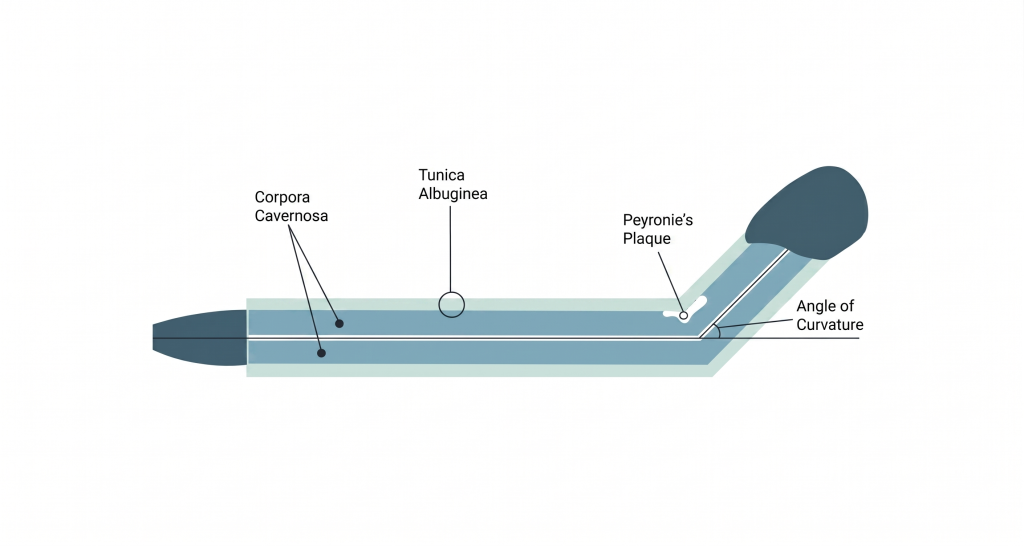
In both cases, the curvature can progress and cause deformities, such as penile narrowing and shortening, as well as pain during an erection. In some patients, erectile dysfunction may also occur.
Is there a most common age for the problem to appear?
There is no single age. Some curvatures are present early on and become more noticeable during puberty, when the penis develops.
In other cases, the curvature appears later, especially between the ages of 40 and 60, frequently associated with Peyronie’s Disease.
When does penile curvature become a problem?
Pain or discomfort
Pain during an erection or during sexual intercourse may indicate that the condition is in its active phase or the presence of fibrosis.
Difficulty with penetration
When the penis is curved, the deformity tends to prevent or hinder penetration, as the penis bends or slips during attempts.
Emotional impact and self-esteem
Many men feel insecure, avoid intimacy, and develop psychological distress associated with the alteration in the penis, especially when there is associated pain or erectile dysfunction.
Types of penile curvature
Penile curvature can present itself in different ways, depending on its origin and progression over time.
Peyronie’s Disease (acquired curvature)
The accumulation of scar tissue can result in:
- Palpable nodule or plaque;
- Pain during erections;
- Penile curvature during erection;
- Abnormal and progressive curvature;
- Decrease in penile length;
- Narrowing or “hourglass” deformity;
- Erectile dysfunction.
Congenital curvature
Congenital curvature is present from development and, by itself, does not cause complications. However, in some situations, it can favor the formation of fibrosis and the development of Peyronie’s Disease.
READ MORE | Does a penile prosthesis increase the size of the penis? Discover the truth
How to straighten the penis?
Penile curvature has several treatment options to help straighten the penis, although not all situations require intervention. The therapeutic decision depends on the intensity of the deviation, the presence of pain, the stability of the clinical condition, erectile function, and the impact on the patient’s sexual life.
The treatment for curvature can, in many cases, initially be performed with clinical approaches, and in more pronounced cases, with surgical approaches, depending on individual medical evaluation.
Clinical treatments
Clinical treatments can be useful in mild cases or in the early stages of penile curvature. In these cases, the goal is to control symptoms, stabilize the progression of the condition, and preserve sexual function.
1. Medication
In the early stages of Peyronie’s Disease, some patients may benefit from drug treatment aimed at stabilizing the progression of the condition.
In addition, analgesics may be indicated for pain control and vasodilating medication to help in cases where there is associated erectile dysfunction.
2. Penile traction therapy
In selected cases, penile traction can be considered as a therapeutic complement.
This approach can be done through manual exercises or with specific devices, aiming to prevent retraction and stimulate tissue elasticity.
The patient must be well guided by the doctor so that there is no risk of new penile injuries.
3. Vacuum pump
The vacuum pump is a device consisting of a cylindrical tube where the penis is inserted and a constriction ring. This tube is connected to a pump that creates a vacuum, favoring the erection and stimulating the tissues of the penis.
It is a complementary approach and can worsen the existing condition if used without medical guidance.
Surgical treatments to straighten the penis
The anatomical correction of penile curvature usually requires surgical intervention. However, surgery is not indicated for all patients. Surgical treatment is generally considered when there is stability of the curvature, significant angulation, and compromised quality of sexual life.
The type of technique depends on the degree of curvature, the available penile length, the complexity of the deformity, and the patient’s erectile function.
1. Nesbit Technique
The Nesbit Technique is the most traditional. It is used to equalize the sides of the tunica albuginea by reducing the longer side of the penis, that is, shortening the side with greater elasticity.
Although this technique allows you to straighten the penis and correct the curvature, it is important to know the potential limitations: the technique can cause a decrease in penile length, on a scale that can vary between 0.5 and 5.0 centimeters, depending on the degree of curvature, and the use of non-absorbable surgical sutures can cause discomfort or pain during sexual intercourse.
2. Egydio Technique
The Egydio Technique is based on lengthening the shorter side of the tunica albuginea, seeking to correct the curvature with a reconstructive approach.
Based on principles of geometric reconstruction, this technique aims to correct the curvature through tissue expansion. In patients with clinical indication, its goal is to preserve, within anatomical limits, penile dimensions and can facilitate the implantation of a penile prosthesis in cases of concomitant erectile dysfunction.
3. Stage Technique
The Stage technique can be used as a complement to penile reconstructive surgery in some specific cases. The goal is to leave the penis more aligned and preserve maximum length within clinical possibilities.
Can the curvature return after treatment?
The surgical correction of the curvature does not guarantee a definitive resolution in all cases, with the possibility of recurrence of the curvature even after treatment.
This can happen due to the underlying cause of the curvature, the emergence of new injuries, or the technique used for correction.
Therefore, medical follow-up is essential. With proper monitoring, the specialist can identify any changes early on and intervene in a timely manner, preventing the condition from worsening.
Contact Dr. Paulo Egydio
The presence of a slight penile curvature can be physiological, as long as it does not impact sexual health or psychological well-being. However, given significant symptoms or worsening of the curvature, evaluation by a urologist is recommended.
To evaluate your clinical case, contact the clinic to schedule a specialized consultation, with an individualized analysis and an appropriate treatment plan aimed at restoring your quality of life.