


Penile implant revision may be necessary when the device no longer works as expected, whether due to mechanical failure, component wear or other changes identified during clinical assessment.
Before undergoing surgery to place a penile prosthesis, a man may clarify questions about the expected durability of the device and the possibility of future penile implant revision. This assessment may contribute to a more informed decision, according to his clinical context.
Although it may be a therapeutic option indicated in selected cases, a penile prosthesis may require maintenance or revision over time.
Even so, it is not possible to determine exactly how long the treatment will remain effective in each case. This depends on the type of device implanted, since each model is associated with a certain failure rate. The type of surgery performed and proper handling of the prosthesis are also relevant factors.
When penile implant revision is necessary
The need for penile prosthesis maintenance or revision occurs when the device no longer functions effectively.
The presence of pain, loss of rigidity or difficulty using the device during an erection may justify clinical assessment, and surgical revision or eventual replacement of the penile prosthesis may be considered according to the cause identified.
How long does a penile prosthesis last?
In general, penile prostheses may remain functional for several years, although durability varies according to the type of device, the surgical technique, the patient’s characteristics and the clinical course.
Implants placed longer ago are more likely to require revision. Even so, in less frequent cases, a man may notice early signs, during the first sexual relations after surgery, that the device is not working as expected.
Durability of inflatable penile prostheses
- 5 years after implantation, the device remained functional in 87.2% of cases;
- 20 years after implantation, the device remained functional in 52.9% of cases.
Durability of semi-rigid (malleable) penile prostheses
The semi-rigid penile prosthesis may have lower mechanical complexity than the inflatable penile prosthesis, which may influence its durability over time.
The 2020 literature review, published in the Journal of Visualized Surgery, reports that:
- 5 years after implantation, the semi-rigid prosthesis remained functional in 88.8% of cases.
- 10 years after implantation, it remained functional in 84.3% of cases.
It is important to note that, despite the possibility of replacement over time, both inflatable penile prostheses and semi-rigid penile prostheses may constitute therapeutic options in selected cases, including situations of refractory erectile dysfunction and Peyronie’s disease, according to individual medical assessment.
Factors that influence penile implant revision and durability
The need for penile prosthesis maintenance or revision may be related to the implanted model, but it also depends on surgical, anatomical and clinical factors. Inflatable prostheses, because they have more mechanical components, may be more subject to revision or replacement due to mechanical failure than semi-rigid models.
In addition, the quality of the implant materials, the type of surgery performed, the patient’s anatomical characteristics and daily use habits also influence durability.
Model and material quality
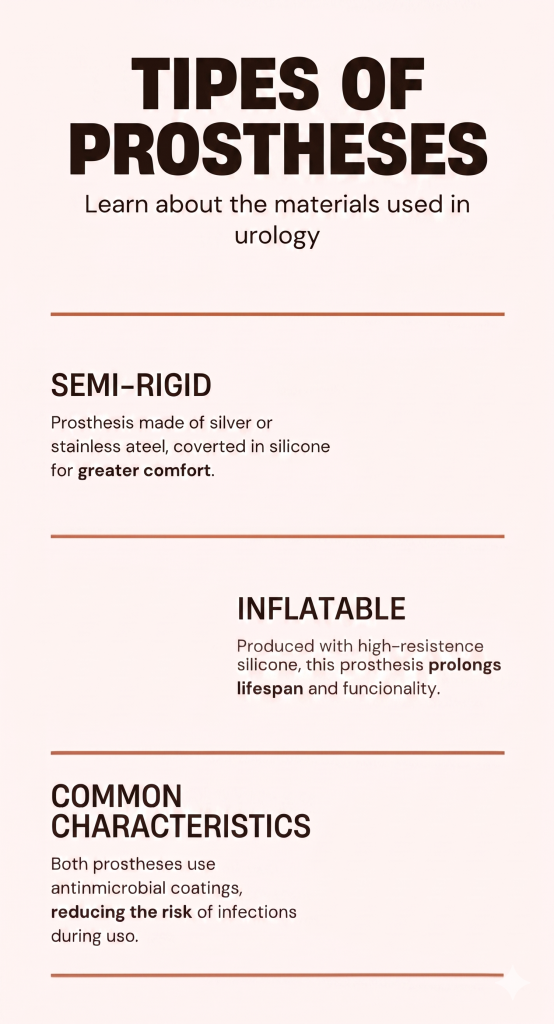
In a semi-rigid penile prosthesis, the materials are designed to withstand repeated mechanical stress: the core may include metal alloys, such as Nitinol, silver or stainless steel, while the silicone coating may contribute to the anatomical adaptation of the device.
These characteristics may allow device positioning with functional maintenance over time, although the clinical course varies between patients. A study published in the Korean Journal of Urology suggests that contemporary malleable models have lower mechanical complexity and a low frequency of failure. In addition, a study published in 2007 in Urology described a low occurrence of mechanical failure in this type of device.
The inflatable penile prosthesis, in turn, is composed of silicone and components such as a scrotal pump, reservoir and cylinders. Because it has greater mechanical complexity, it may be associated with functional failures, pump blockage or leakage of saline solution over time.
Both types of prosthesis may include antimicrobial coatings, with the aim of reducing the risk of infection, one of the main causes of early implant replacement.
Type of surgery
There are different surgical approaches for penile prosthesis placement. In some cases, the implant is placed as an isolated procedure. However, when curvature, narrowing or associated deformity is present, penile reconstruction may be required during the same surgical act.
Surgery with penile reconstruction is not limited to prosthesis placement: it may also address deformities that influence function, penile anatomy and aesthetic outcome, according to individual clinical assessment.
Therefore, it is important that the procedure is assessed by a physician qualified in this area. Clinical assessment makes it possible to consider whether the patient requires an associated reconstructive approach, according to his anatomy, functional condition and therapeutic objectives.
Postoperative follow-up and appropriate guidance on handling the device are relevant aspects for the use of the penile prosthesis over time.
Penile anatomy
Penile anatomy should be considered when planning a penile prosthesis, in order to guide individualised strategies for each case.
In cases of a longer penis, for example, it may be necessary to consider prostheses with a compatible diameter, since cylinders that are too narrow may be associated with lower stability during sexual intercourse.
When the penis has a smaller girth and cannot accommodate a larger-diameter implant, penile reconstruction may be considered, with relaxing incisions in the tunica albuginea, with the aim of favouring tissue expansion and the possible accommodation of a wider penile prosthesis, when clinically indicated.
Patient habits
Use habits and day-to-day care may also influence the durability of the penile prosthesis.
In the case of the semi-rigid prosthesis, the way the patient positions the penis in underwear and some postural habits may influence device use over time. Guidance on positioning and daily care should be individualised and provided by the responsible medical team.
In the case of the inflatable prosthesis, improper handling, namely applying excessive force to the pump or cylinders, may contribute to wear or functional failures of the components over time.
Clinical assessment for penile implant revision
Although this is not the most frequent situation, whenever signs appear that the penile prosthesis is no longer working as expected, it is advisable to seek specialist medical assessment. In some cases, surgical revision or replacement of the prosthesis may be considered, depending on the type of implant, the symptoms presented and the cause identified.
For clarification of questions and individual clinical assessment, contact the clinic to request information about a specialist medical consultation.