

Although it is not possible to use the term ‘cure’ for Peyronie’s Disease, there are different therapeutic approaches that may potentially help improve penile function and reduce the impact of the condition.
The answer to the question ‘Does Peyronie’s Disease have a cure?’ is no. According to scientific literature and the European Association of Urology (EAU), treatment may be used to control symptoms, stabilize the disease and functionally correct curvature.
The absence of a definitive cure may cause concern for men living with the physical, sexual and emotional effects of the condition. However, depending on various clinical factors, an appropriate therapeutic approach can be defined for each case.
Currently, there are different treatment options that may potentially help improve the condition, but selection of the most appropriate approach should be made after a specialized assessment by a urologist.
In addition, it is important for the patient to have realistic expectations about the results, as these may vary according to the stage of the disease, the severity of curvature, erectile function and the individual response to treatment.
What is Peyronie’s Disease?
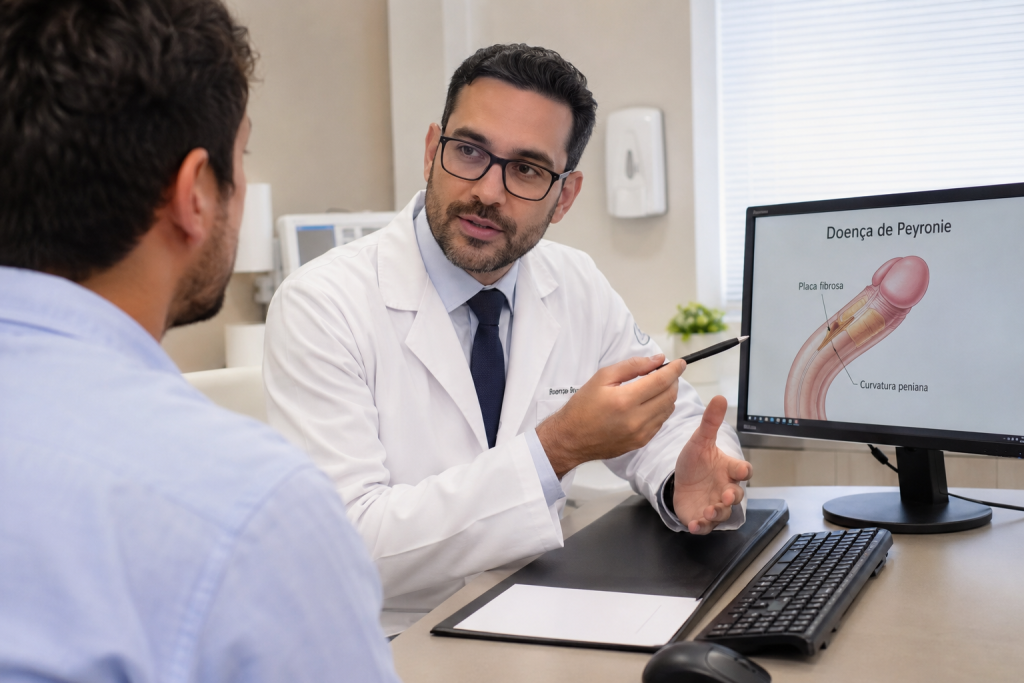
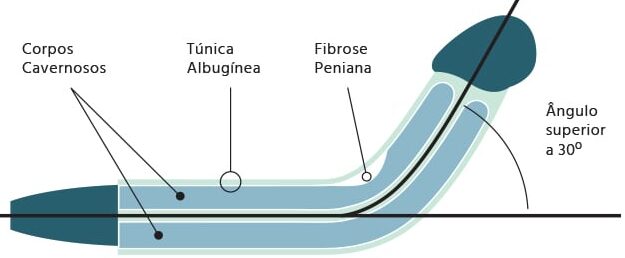
The condition is characterized by the formation of fibrous plaques in the tunica albuginea. These plaques may reduce tissue elasticity and cause acquired curvature during erection.
In the acute phase, there is an inflammatory process that may favor the onset or worsening of curvature, often associated with penile pain.
In the stable phase, inflammation may decrease and penile curvature becomes more defined, with a lower likelihood of progression.
Symptoms of Peyronie’s Disease
Not all cases progress in the same way; therefore, the symptoms of Peyronie’s Disease may vary.
The most common signs are noticed during erection and include:
- Penile curvature;
- Penile narrowing;
- Reduced penile length;
- Palpable nodules or hardened areas;
- Penile pain (especially in the initial phase);
- Difficulty or inability to penetrate;
- Loss of rigidity or erectile dysfunction.
Does Peyronie’s Disease Have a Cure? Can It Go Away on Its Own?
Spontaneous and complete regression of curvature is uncommon.
A review published in the Asian Journal of Urology indicates that spontaneous resolution of penile curvature occurs in only about 3% to 13% of cases.
This means that, although pain may improve and curvature may stabilize, especially after the initial inflammatory phase, it is not prudent to assume that the penile deformity will disappear.
Creating this expectation may delay diagnosis and limit the therapeutic options available.
Does Peyronie’s Disease Have a Cure? Treatment Options Available Today
The best way to treat Peyronie’s Disease should be defined by a urologist after specialized assessment.
The approach depends on several factors, such as the stage of the disease, severity of curvature, presence of pain, erectile function, ability to penetrate and the patient’s expectations.
Clinical monitoring
Clinical follow-up may be indicated in mild situations, especially when curvature does not prevent sexual activity, pain is manageable and there are no signs of significant progression.
In these cases, the aim is to monitor the disease’s course, assess changes in curvature and follow potential impacts on erectile function.
Medications
Medications may have a role in specific situations, mainly to control pain, inflammation or associated erectile dysfunction, especially in the initial stage of the condition or when symptoms interfere with sexual quality of life.
Complementary therapies and non-surgical approaches
Some complementary therapies, such as penile traction devices, Kegel exercises and shockwave therapy may be considered in specific contexts.
These approaches are not intended to reverse curvature and aim to potentially help preserve penile length and reduce the functional impact of the deformity.
Reconstructive surgery
The surgery for Peyronie’s Disease may be considered when curvature significantly compromises sexual activity.
This treatment for penile curvature should only be indicated after careful assessment, explanation of benefits, risks and limitations, and alignment of the patient’s expectations.
When may surgery be considered?
Surgery may be a therapeutic option for Peyronie’s Disease. Generally, this approach is considered when:
- Fibrosis is in the stable phase;
- Marked curvature that makes penetration difficult or impossible;
- Limited movement during sexual activity;
- Erectile dysfunction is associated.
Before making any decision, it is important to undergo a specialized assessment, since not all patients are candidates for surgical treatment.
Is it possible to recover sexual function?
Some cases of Peyronie’s Disease may be associated with erectile dysfunction. In these cases, treatment should consider not only the penile deformity but also sexual function.
Recovery of sexual function—that is, the ability to achieve and maintain sufficient rigidity for penetration—may potentially depend on the placement of a penile prosthesis during reconstructive surgery.
It is important to emphasize: improvement in sexual function does not mean that the condition has been ‘cured,’ but it may potentially represent an important functional recovery for the patient.
When should specialized assessment be sought?
Specialized assessment should be considered as soon as a man notices typical symptoms of Peyronie’s Disease.
The earlier the assessment is performed, the better the understanding of the stage of the disease, monitoring of its course and definition of an appropriate approach.
Peyronie’s Disease has treatment, and seeking medical help should not be a reason for embarrassment or fear. A consultation with a urologist or andrologist should be viewed as a confidential setting prepared to address this type of concern without judgment.
Frequently asked questions
Can Peyronie’s Disease be completely reversed?
It is not always possible to completely reverse Peyronie’s Disease. Available treatments may potentially help control symptoms, stabilize the disease and potentially improve curvature and sexual function.
How long does treatment for Peyronie’s Disease take?
There is no fixed timeframe for treating Peyronie’s Disease, as the aim is to control symptoms, stabilize the disease and reduce functional impact.
What happens if Peyronie’s Disease is not treated?
Without follow-up, curvature may stabilize, but it may also progress and make penetration difficult, cause pain, affect erection and generate emotional and sexual impact.
What can worsen Peyronie’s Disease?
Peyronie’s Disease may potentially worsen with new penile trauma. The absence of follow-up may delay diagnosis and limit the therapeutic options available.
Specialized assessment for Peyronie’s Disease
If you have symptoms compatible with Peyronie’s Disease or questions about the available therapeutic options, schedule a specialized assessment.