


Candidates for a penile implant should present clear clinical criteria that justify the surgical recommendation, such as severe erectile dysfunction.
Traditionally, many men avoid admitting that they face health problems in the sexual sphere. In addition, they often conceal erection difficulties and are unaware of the available treatments.
If you experience difficulties with intimacy and there is suspicion or a diagnosis of erectile dysfunction, it is advisable to seek medical assessment to understand the possible causes and the therapeutic options suitable for your case.
Erectile dysfunction is a common condition and can be addressed with different therapeutic options, including tablets, intracavernosal injections and, in selected cases, penile implants.
In addition, doctors usually choose, as a first step, more conservative and non-invasive therapeutic approaches, such as tablets and intracavernosal injections, which may be effective in many cases.
Penile implants may be considered for patients who do not respond adequately to tablets or injections, who experience relevant side effects, or when these options become ineffective over time, always after an individualized medical assessment.
Signs that may justify assessment for a penile implant
When discussing penile implants, advantages and disadvantages arise in the conversation, not only regarding the procedure itself, but also its real need and the most appropriate timing for implantation.
Below are some signs that may justify a urological assessment, emphasizing that the decision regarding treatment should be made individually, after clinical analysis and discussion of the most appropriate options for the case.
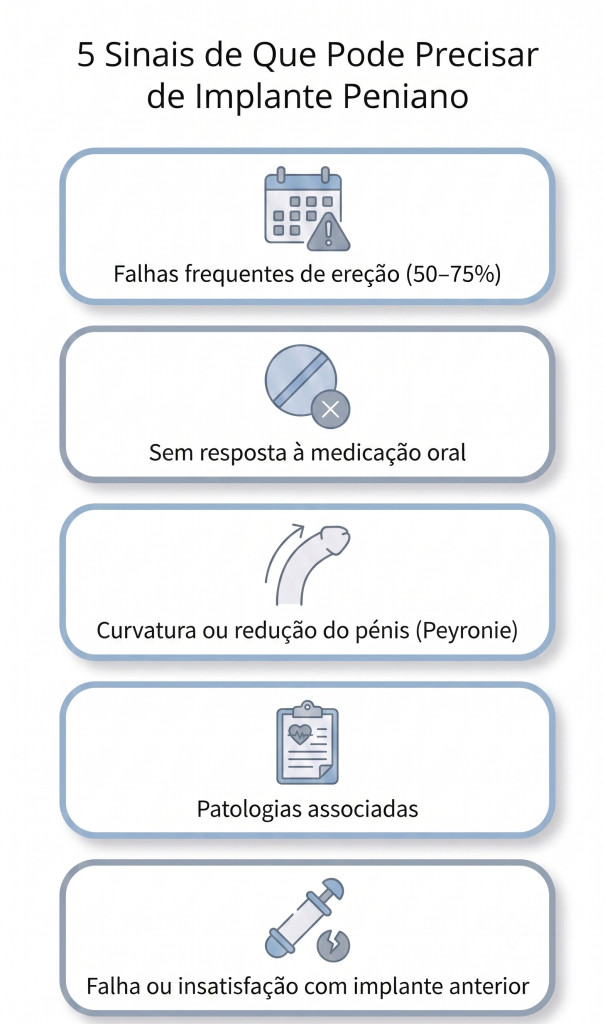
1 ) It is not always erectile dysfunction
Occasional situations do not constitute signs of erectile dysfunction. After all, it is normal for a man to experience occasional failures. Anxiety, stress, pressure, among other factors, may affect the response to sexual stimuli.
Erectile dysfunction may justify medical assessment when it occurs repeatedly and interferes with sexual activity. It may present in the following ways:
- Absence of an erection even with sexual stimulation;
- Difficulty obtaining or maintaining an erection;
- Lack of sufficient rigidity for penetration;
- Presence of penile curvature;
- A penis that loses the erection or slips out easily during sexual intercourse;
- Reduction in involuntary, nocturnal and morning erections.
Many cases can be treated with oral or injectable medication. Therefore, only more severe cases are indicated for surgical treatment.
2) Health conditions that may be associated with erectile dysfunction
Certain health conditions may be associated with more complex cases of erectile dysfunction and, in some cases, with a limited response to conservative treatments.
For this reason, men with some of the conditions listed below may benefit from urological assessment to understand whether there is an indication for specific treatments, including, in selected cases, a penile implant:
- Diabetes;
- Obesity;
- Peyronie’s disease;
- High blood pressure;
- Priapism;
- Prostate cancer;
- Reduced testosterone levels;
- Depression;
- Alcohol dependence and smoking.
3) When there is reduction in penile size or curvature
Reduced penile length and penile curvature caused by Peyronie’s disease may lead to erection difficulties.
In these cases, when there is a clinical indication, the implant may be associated with a planned penile reconstruction procedure, with the aim of improving penile functionality and rigidity.
In selected situations, the Egydio Technique and geometrically planned penile reconstruction techniques may be used to adapt the implant to the patient’s anatomical characteristics and optimize functionality, always according to clinical criteria and recognized urological recommendations, including documents from the American Urological Association (AUA ), Canadian Urological Association (CUA ) and European Association of Urology (EAU ).
It is important to emphasize that, although in some cases there may be changes in the appearance of the penis, the main purpose of surgery is functional, seeking to support suitable conditions for sexual activity, according to medical assessment and the characteristics of each patient.
4) When the surgical indication has already been discussed in a medical consultation
If you have already sought assessment with a urologist in Portugal and received an indication for penile implant placement after clinical evaluation, it is important to clarify doubts with reliable sources and with the medical team responsible for your care.
Consulting reliable, evidence-based sources may help you better understand the procedure, provided that this does not replace individualized medical assessment.
This information may help the patient understand the advantages, limitations, different prosthesis models, costs involved, recovery and realistic expectations after surgery.
5) When there are doubts or difficulties after implant placement
Replacement of the penile prosthesis may be necessary in some patients.
In some cases, complications or functional results below expectations may occur after the initial surgery, including healing problems, prosthesis extrusion, implant instability or other situations that should be assessed by a urologist.
In some cases, the chosen implant model may, over time, no longer correspond to the patient’s clinical or functional needs.
This may happen when a patient with motor limitations in the hands chooses an inflatable prosthesis, which requires manual strength to activate the pumping mechanism.
In addition, revision surgery may be necessary in situations of implant malfunction.
In general, inflatable implants may present a higher risk of mechanical failure and a greater likelihood of requiring revision or replacement when compared with the malleable prosthesis.
In addition to surgical aspects, mental health and appropriate follow-up may influence adaptation to the implant and the return to sexual activity, and should be considered as part of the patient’s overall care.
Egydio Technique and urological assessment
The indication for penile implant placement should be confirmed by a urologist after an individualized clinical assessment.
If you suspect severe erectile dysfunction, or if you have questions about the need to assess an existing implant, it is advisable to seek guidance from a healthcare professional.
To clarify doubts about erectile dysfunction, penile implants, the Egydio Technique or a possible need for reassessment, you may seek a urology consultation and use the available contact channels to obtain more information.
Medical follow-up should be carried out with discretion, confidentiality and respect for each patient’s individual needs.