

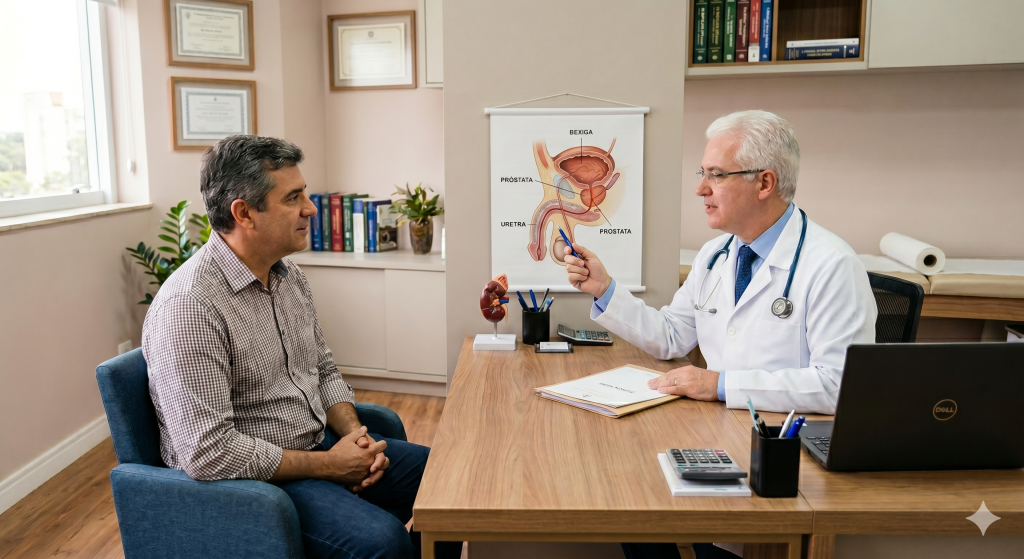
Recovery of penile elasticity after Peyronie’s surgery depends on the technique used, tissue healing and appropriate postoperative follow-up.
Peyronie’s Disease surgery may correct penile curvature and potentially improve sexual function. Even so, the postoperative period may raise concerns about expectations for the result.
At this stage, some men notice that the penis feels less elastic. Others perceive a different erection. There may also be concern that penile firmness after Peyronie’s surgery will not return to what is expected.
However, in most cases, recovery occurs in phases. Tissues need time to heal, adapt and regain some flexibility. Therefore, recovery of penile elasticity after Peyronie’s surgery should be evaluated realistically and with medical follow-up.
What happens to penile tissues after Peyronie’s surgery?
After surgery, the tunica albuginea undergoes a natural repair process. During this process, the patient may expect:
- Initial inflammation and healing of the operated area;
- Progressive remodeling of penile tissues;
- Adaptation of the tunica albuginea to the new anatomy.
Penile elasticity after surgery does not return immediately. First, the body needs to control inflammation; then the tissues begin to regain mobility and resistance. The remodeling phase may extend over several months.
What affects recovery of penile elasticity after Peyronie’s surgery?
Recovery after Peyronie’s surgery is not the same for every patient. The result depends on the initial presentation, the technique used and the individual healing response.
Severity of the disease before surgery
More pronounced curvatures, hourglass deformities, extensive plaques or significant shortening may require more complex surgeries. In these cases, functional recovery after Peyronie’s surgery tends to require more time.
When the condition has already compromised the elasticity of penile tissues before surgery, recovery may be slower and partial.
Condition of penile tissues
Tissue quality directly influences recovery. When the fibrous plaque is more extensive, calcification is present or there is already loss of elasticity, tissues may take longer to expand again during erection.
The patient may notice rigidity, less flexibility or a difference in erection firmness during the first few months.
Surgical technique used
Surgical techniques for Peyronie’s Disease may include shortening procedures, lengthening with a graft or placement of a penile prosthesis in selected cases. The choice depends on the deformities and erection quality.
When surgery is performed using the tunica expansion technique, the aim is to reconstruct the area affected by the fibrous plaque and potentially help the penis expand more appropriately. Changes in elasticity depend on healing, tissue adaptation and the rehabilitation recommended by the physician.
Associated erectile dysfunction
When the patient already had difficulty maintaining an erection before surgery, recovery of firmness may be slower or require additional care. This occurs because, in addition to correcting the deformity, it may also be necessary to treat the associated erectile dysfunction .
In some cases, the physician may consider placement of a penile prosthesis.
How does erection firmness recover after surgery?
Erection firmness after surgery depends on the type of procedure performed. When surgery involves only tissue reconstruction, recovery of rigidity is related to healing, blood circulation and the response of the corpora cavernosa.
When, in addition to reconstruction for Peyronie’s Disease, the patient also receives a penile prosthesis, erection rigidity is provided by the implant rather than solely by the natural response of the corpora cavernosa.
Even with a prosthesis, adaptation is not immediate. In the first few weeks, there may be pain, swelling, a different sensation of rigidity and concern about manipulating the implant. With healing and medical guidance, the patient learns to use the prosthesis and better recognizes the new pattern of firmness.
What is the role of penile rehabilitation in recovery?
Penile rehabilitation may play an important role in the postoperative period after Peyronie’s surgery. Its aim is to potentially support functional recovery, reduce scar stiffness and aid tissue adaptation.
When indicated, it may include:
- Postoperative rehabilitation protocols, defined according to the surgical technique and healing stage;
- Use of devices, such as vacuum devices or penile traction;
- Specialized follow-up, to assess progress and guide a gradual return to activities.
What results may be expected?
The results of Peyronie’s surgery should be assessed together: curvature, sexual function, elasticity, firmness and patient satisfaction.
1) Correction of penile curvature
The main objective of surgery is to correct penile curvature that makes sexual activity difficult or prevents it. In many cases, it may be possible to achieve a functionally straighter penis.
2) Improvement in sexual function
3) Progressive recovery of elasticity
Recovery of penile elasticity after Peyronie’s surgery may be gradual. Initial tissue stiffness may potentially decrease as healing progresses and remodeling is completed.
During this period, the patient may notice:
- A reduced sensation of tension over the months;
- Progressive improvement in expansion during erection;
- Greater comfort during sexual activity.
4) Possible limitations of recovery
Not all patients recover in the same way. Limitations may occur, such as residual curvature, changes in sensation, shortening, persistent pain or erectile dysfunction.
These limitations should be discussed with the patient, without promising the same results for everyone.
How long does recovery from Peyronie’s surgery take?
Recovery from reconstructive surgery for Peyronie’s Disease ranges from 45 to 60 days, depending on each patient’s body.
The first weeks are usually more related to pain control, swelling and wound healing. During this period, the patient should avoid physical exertion.
Return to work depends on the type of occupation. In roles with little physical demand, returning may be possible after a few weeks, always according to medical guidance. Jobs that require exertion, long periods standing, prolonged driving or lifting weights may require a longer leave period.
Physical exercise should be resumed gradually. Impact sports, weight training, cycling, running and activities that increase pressure on the pelvic region usually require a longer wait, often around one month or according to the physician’s assessment.
The resumption of sexual activity may occur after adequate healing and assessment at a consultation, generally within 45 to 60 days. This timeframe may vary if there is pain, persistent swelling, more complex reconstruction or placement of a penile prosthesis.
However, functional recovery may continue for several months. Elasticity, firmness, sensation and comfort during sexual intercourse tend to progress gradually, making ongoing medical follow-up essential.
When should a new medical assessment be sought?
Medical follow-up is an important part of recovery. Consultations make it possible to assess healing, erection, sensation and return to sexual activity.
In addition to scheduled appointments, a man should seek a new assessment if there is:
- Persistent pain beyond the expected period;
- Changes in erection or loss of firmness;
- Significant residual curvature or uncertainty about progress;
- Complications such as fever, sudden increase in swelling, wound discharge or hematoma;
- Questions or difficulty following postoperative instructions.
Recovery of penile elasticity after Peyronie’s surgery is gradual and depends on several factors
Recovery of penile elasticity after Peyronie’s surgery occurs in stages, with an individual response. The most important point is to maintain realistic expectations and ongoing medical follow-up.
If you have undergone surgery for Peyronie’s Disease and would like to better understand the progress of your recovery, a specialized assessment may help clarify questions and optimize postoperative care. Contact the clinic to schedule a specialized consultation.