

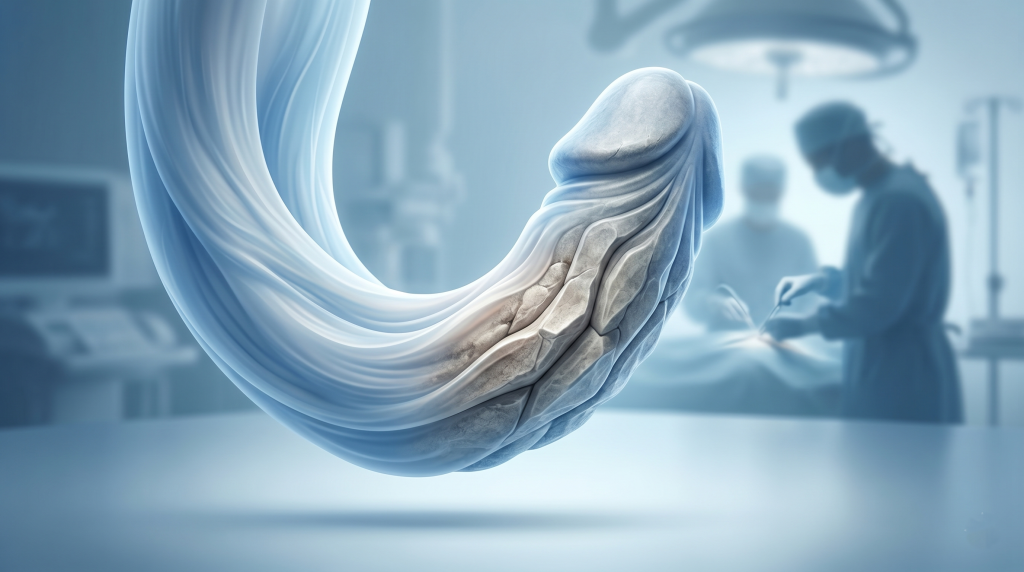
Calcified Peyronie’s disease causes damage to sexual relations and requires a more complex and personalized surgical approach.
There are men who live with Peyronie’s Disease for months or years before seeking medical help. The risk of delaying this moment is that it can allow the disease to progress, with possible progression of the curvature and, in some cases, fibrotic calcification.
Without adequate evaluation, it is not possible to know how the internal area is affected. The longer the patient spends without diagnosis and follow-up, the greater the risk that penile fibrosis will become calcified and hard, with possible reduction of response to clinical treatments. At that point, sexual relations can become difficult.
However, calcified Peyronie’s disease may have treatment options. In this case, penile reconstruction surgery can be considered, in accordance with international guidelines for treating the condition.
What is calcified Peyronie’s disease and why does the plaque become hard
Peyronie’s Disease is characterized by the formation of a fibrous plaque on the tunica albuginea.
When this plaque calcifies, the tissue can lose a great deal of its elasticity and begin to behave like a hard penile plaque during erection, potentially favoring deformities and reduction of rigidity.
Evolution of the fibrotic plaque
Peyronie’s Disease begins with an inflammatory process, with emergence and possible progression of the curvature. As the condition evolves, it can reach the chronic phase of Peyronie’s. In this phase, the plaque can stabilize and the curvature can stop progressing.
Over time, deposition of collagen can occur in the fibrosis, which can leave the plaque thicker. Depending on the organism, the loss of elasticity can worsen, potentially leading to progressive hardening of the plaque.
What calcification means in practice
Calcification corresponds to the process of calcium deposit within the fibrotic plaque over time, giving rise to the calcified plaque of Peyronie’s disease.
When calcified, the plaque becomes harder and less able to accompany the natural expansion of the penis during erection. The result is a more rigid deformity, with greater functional limitation during sexual intercourse.
Difference between soft plaque and hard plaque
The difference between soft plaque and hard plaque is essential for defining treatment.
- Soft plaque: can preserve some flexibility in the initial phase of Peyronie’s Disease. Depending on the case, it can respond to conservative and complementary therapies.
- Hard or calcified plaque: can prevent adequate flexibility of penile tissue and may have limited response to conservative and complementary treatments. It may be necessary to consider more complex penile surgery.
Why clinical treatments stop working
Clinical treatments are most useful when the disease is still in the inflammatory phase. They are indicated for pain and difficulty with rigidity during sexual intercourse, helping the patient maintain sexual life.
However, medications, complementary therapies and non-invasive approaches do not have the ability to reverse a calcified curvature or restore lost elasticity.
For this reason, when there is a calcified plaque of Peyronie’s disease, these alternatives may have limited effectiveness, particularly when there is rigid deformity and limitation of penile function.
When the disease enters the stable phase
This phase occurs when the plaque stabilizes, becomes firmer, less elastic and, in some cases, calcified.
Read more: Physiotherapy and Penile Extenders in Post-Peyronie’s Surgery: Accelerating Recovery
When surgery becomes indicated
Surgical indication should be considered after a urologist evaluates the stabilization of the fibrosis. It does not depend only on the degree of curvature, but also on the functional impact on the patient’s sexual life.
Clinical criteria for surgical indication
Surgery for calcified Peyronie’s disease can be considered when there is:
- Significant curvature;
- Erectile dysfunction;
- Difficulty or impossibility of penetration;
- Areas of thinning;
- Shortening of penile length;
- Failure of conservative treatment.
It is important to note that surgery is reserved for situations where the fibrosis is proven to be stabilized and does not respond to clinical approaches.
Read more: How much does Peyronie’s disease surgery cost
Impact on quality of life
Calcified Peyronie’s disease does not affect only the structure of penile tissues. The condition can also be associated with changes in psychological well-being, particularly when the man discovers that the condition is more serious and complex than he expected.
Deformities and erectile dysfunction can already naturally compromise sexual life.
Individual evaluation of the case
Each patient candidate for the surgical procedure must be analyzed in detail. The surgeon evaluates the following factors to determine the most appropriate surgical strategy:
- Degree and direction of curvature;
- Associated deformities (loss of length and thinning);
- Extent of calcification;
- Quality of erection;
- Sensitivity.
This evaluation allows to define the most appropriate technique for correcting the severe curvature and restoring penile functionality.
It is also important to align patient expectations before surgery. The patient must understand that surgery aims to allow sexual relations with greater predictability, in addition to understanding the risks involved and the type of recovery expected.
Surgical approach for calcified Peyronie’s disease
Surgery for severe Peyronie’s disease often requires a combined surgical approach: it is necessary to reconstruct the area affected by the plaque and restore penile rigidity.
Reconstruction is achieved through microincisions in the calcified plaque. With the relaxation of hardened tissues, it may be possible to align the penis and allow it to expand more balanced.
Beyond this, this relaxation can allow tissue expansion. Thus, during the same procedure, the surgeon can act on the restriction of size and caliber, seeking to restore the penile dimensions to the anatomical limit of the patient.
As calcified Peyronie’s disease is often associated with erectile dysfunction, isolated reconstruction may not be sufficient to restore rigidity, even when the curvature is corrected.
In these cases, the implantation of a penile prosthesis can be fundamental to restore functional rigidity.
Altogether, the treatment of Peyronie’s disease with calcification seeks to correct deformities, restore penetrative function and potentially contribute to changes in sexual quality of life.
Read more: Egydio Technique for Severe Curvatures: How It Works and Why It’s Different
The challenges of surgery in calcified plaques
Surgery in calcified Peyronie’s disease is more complex because hardened tissue makes reconstruction of the affected area difficult.
Greater tissue rigidity
Risk of functional loss
For this reason, if the surgical strategy does not include the placement of a penile prosthesis when this is necessary, the patient can continue to experience difficulty in achieving or maintaining an adequate erection for sexual relations.
Need for surgical experience
Calcified cases require a surgeon with specific experience. It is important to choose the most appropriate technique for each patient, plan the intervention in an individualized manner and execute the surgery with technical precision.
Furthermore, the surgeon must know how to evaluate when the penile prosthesis is necessary, what the most appropriate dimension is and how to adapt the surgery to the patient’s anatomy.
It is also fundamental to preserve the cavernous bodies, favoring the best possible residual filling, and protect the nerve structures responsible for sensitivity.
Is it possible to recover function and quality of life?
In many cases, it may be possible to restore penile function and potentially contribute to changes in sexual quality of life of the patient. For this, the approach must be adequate to the case. However, surgery should not be viewed as a guarantee of results.
Expected results
Contact the clinic to schedule a specialized consultation: Schedule your appointment