


Treatment for prostate cancer in older adults may involve active surveillance, hormone therapy, radiotherapy, chemotherapy or surgery, depending on the stage of the disease, the patient’s general health and individual preferences.
Prostate cancer is a common disease in the male population, especially with advancing age. When diagnosed at an early stage, it may have a better prognosis and a greater possibility of clinical control, depending on the characteristics of the tumour, the patient’s general health and the therapeutic approach indicated.
What is prostate cancer?
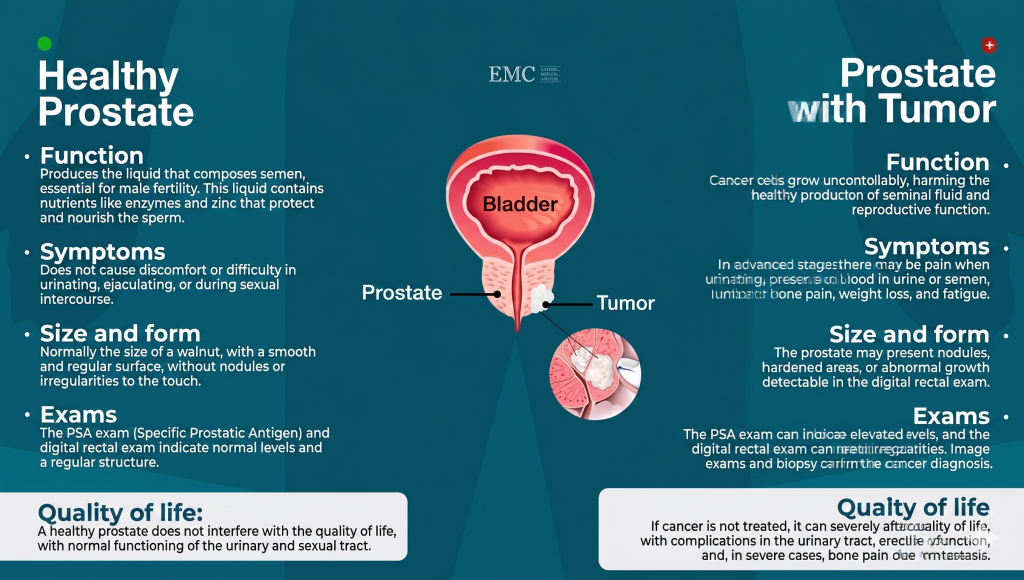
Prostate cancer is a malignant tumour that develops in the prostate, a gland responsible for producing part of the seminal fluid in the male reproductive system.
This disease occurs when prostate cells undergo genetic changes that lead to abnormal and uncontrolled growth. As the disease progresses, tumours may form and, in some cases, may spread to other parts of the body, such as the bones and lymph nodes.
According to official national statistics provided to Eurostat and the OECD, prostate cancer is the most common type of cancer among men in Portugal.
Diagnosis may involve tests such as PSA, clinical assessment, digital rectal examination, imaging tests and prostate biopsy. Treatment varies according to the stage of the disease, age, general health and the patient’s priorities.
Risk factors for prostate cancer in older adults
Advancing age is one of the main risk factors for prostate cancer. The likelihood of diagnosis increases with ageing, which is why individualised prostate assessment may become more relevant later in life.
Another relevant factor is family history. Individuals with a father, brother or other close relatives diagnosed with prostate cancer before the age of 60 should discuss their individual risk with a doctor.
In addition, excess weight, obesity and certain gene mutations may be associated with a higher risk of developing or progressing the disease.
Symptoms of prostate cancer
In the early stages, prostate cancer may be asymptomatic, as the disease can develop slowly. Some cases may progress without clear signs for years and may only be identified during medical assessments.
When symptoms occur, they may include:
- Difficulty urinating;
- Weak or interrupted urine stream;
- Frequent need to urinate, especially at night;
- Feeling that the bladder has not fully emptied;
- Pain or burning when urinating;
- Blood in the urine or semen;
- Pain in the lower back, hips or thighs;
- Erectile dysfunction;
- Pain during ejaculation;
- Unexplained weight loss;
- Fatigue.
These symptoms may also be associated with other benign prostate conditions. Therefore, medical assessment is essential to clarify the cause.
How the diagnosis is made
First, it is important to distinguish prostate cancer from benign prostatic hyperplasia (BPH ). BPH is a benign condition, common with ageing, in which the prostate also increases in size.
The tests requested by the urologist may include:
- PSA: a blood test that measures prostate-specific antigen levels. Elevated values may be associated with cancer, but also with benign conditions;
- Digital rectal examination: a clinical examination that allows assessment of changes in the size, consistency or shape of the gland.
When suspicious changes are found, additional tests, such as magnetic resonance imaging and prostate biopsy, may be needed to confirm or exclude the diagnosis.
Cancer staging
When a diagnosis of prostate cancer is confirmed, the next step is to assess the stage of the disease. Tumour staging helps determine whether the condition is limited to the prostate or whether it has spread to other areas of the body.
For this purpose, tests such as magnetic resonance imaging, computed tomography, bone scintigraphy or other examinations indicated by the doctor may be performed.
The prognosis varies according to the stage of the disease, the characteristics of the tumour and the patient’s individual condition. This assessment is essential to define treatment for prostate cancer in older adults.
Screening for prostate cancer in older adults
Screening for prostate cancer is not recommended indiscriminately for all men. The decision should be individualised, taking into account age, family history, urinary symptoms, previous test results and other relevant clinical factors.
The decision to undergo screening should be shared between doctor and patient. In older adults or in people with other medical conditions, the test may detect small, slow-growing changes that would never affect the person’s health. In such cases, the result may cause unnecessary concern.
What are the treatment options for prostate cancer in older adults?
The choice of treatment for prostate cancer in older adults depends on several factors: stage of the disease, tumour aggressiveness, presence of other medical conditions, patient well-being and life expectancy.
In some cases, the aim may be to treat the disease actively. In others, it may be more appropriate to prioritise clinical control, symptom relief and the preservation of quality of life, always according to an individual medical assessment.
The urologist may recommend a single approach or combine different treatments for prostate cancer in older adults.
1. Active surveillance
When the tumour is considered low risk, or when the patient’s general condition justifies a less invasive approach, active surveillance may be an option, while maintaining the possibility of treatment if there are signs of progression.
In this strategy, the patient is monitored periodically with examinations, blood tests and consultations, allowing the disease to be observed without the need for immediate therapeutic intervention.
2. Surgery for prostate cancer
Radical prostatectomy is one of the surgical options for prostate cancer, especially when the disease is localised and the patient has the clinical conditions required for the procedure.
The surgery consists of removing the prostate and nearby structures.
In older adults, this decision requires careful assessment. As it is a surgical procedure, it is necessary to consider anaesthetic risk, associated diseases, functional recovery and impact on quality of life.
Radiotherapy and chemotherapy may be part of prostate cancer treatment, but they have different indications.
Radiotherapy uses high-energy radiation to act on malignant cells. It may be indicated as the main treatment in some cases, after surgery or in situations where surgery is not the best option.
Chemotherapy uses medicines that act on cancer cells in different areas of the body. This approach may be considered in more advanced stages of the disease or when specific clinical criteria are present.
4. Hormone therapy
Many prostate tumours depend on testosterone to grow. Hormone therapy aims to reduce or block the action of this hormone, helping to control disease progression.
This treatment may be carried out with medicines or, in some cases, through a surgical procedure called orchiectomy, which removes the testicles.
Hormone therapy is not necessarily curative, but it may help delay disease progression and may also be combined with radiotherapy or other approaches.
Possible side effects include erectile dysfunction, mood changes, weight gain, hot flushes, loss of muscle mass and metabolic changes.
5. Immunotherapy
Immunotherapy may be considered in specific situations in oncology, usually in more advanced disease or when clinical criteria justify this approach.
This therapy seeks to stimulate the immune system to recognise and fight malignant cells. However, the response may vary.
Possible side effects include fatigue, thyroid changes and autoimmune reactions.
How is the most appropriate treatment chosen?
The choice of treatment for prostate cancer in older adults should be individualised and discussed between doctor and patient.
The decision considers several factors, such as:
- Stage and aggressiveness of the disease;
- Patient’s age;
- Presence of other health conditions;
- Patient autonomy and frailty;
- Risks and benefits of each treatment;
- Impact on urinary, sexual and bowel function;
- Patient preferences.
When there are significant additional health conditions, it may be necessary to avoid more aggressive treatments. In people with low-risk disease or very advanced age, less invasive strategies, such as active surveillance, may be more appropriate.
The aim is to define, together with the patient, an appropriate balance between prostate cancer control, the clinical safety of the chosen approach and the preservation of quality of life.
Listening to the patient, understanding their priorities and clearly explaining the possible effects of each approach are essential steps towards a safer and more humanised therapeutic decision.
Is prostate cancer in older adults treatable?
Treatment for prostate cancer in older adults is possible, but the approach depends on the characteristics of the disease and each person’s clinical condition.
When identified at an early stage, there may be a greater possibility of clinical control, depending on the characteristics of the tumour and the patient’s general condition. In more advanced stages, there may also be options intended to control the disease, relieve symptoms and help preserve quality of life.
The choice of treatment should be made with the support of a urologist, who can assess the case individually, clarify questions and guide the patient regarding the available options. If you have symptoms, questions or a diagnosis of prostate cancer, seek specialist medical assessment.