


Candidates for a penile implant should meet clear clinical criteria that justify surgical recommendation, such as severe erectile dysfunction.
Some men may find it difficult to talk about sexual health problems, including changes in erection, and may be unaware of the available assessment and treatment options.
If you have persistent difficulties with intimacy and there is a suspicion or diagnosis of erectile dysfunction, it is advisable to seek medical assessment to understand the possible causes and treatment options.
A erectile dysfunction is a common condition and may have different therapeutic approaches, including oral medication, intracavernosal injections and, in selected situations, penile implants.
In addition, doctors usually opt first for more conservative and non-invasive therapeutic approaches, such as tablets and intracavernosal injections, which may be effective in many cases.
Penile implants may be considered in patients who do not respond adequately to conservative treatments, who have relevant side effects or in situations where these options become less effective over time.
Signs you may need a penile implant evaluation
When discussing a penile implant, advantages and disadvantages are part of the conversation, not only regarding the procedure itself, but also regarding its real need and the most appropriate time for implantation.
It is important to know some signs that may justify a medical assessment, noting that the decision about treatment must be individualised and made by a urologist, according to the patient’s clinical history, symptoms and preferences.
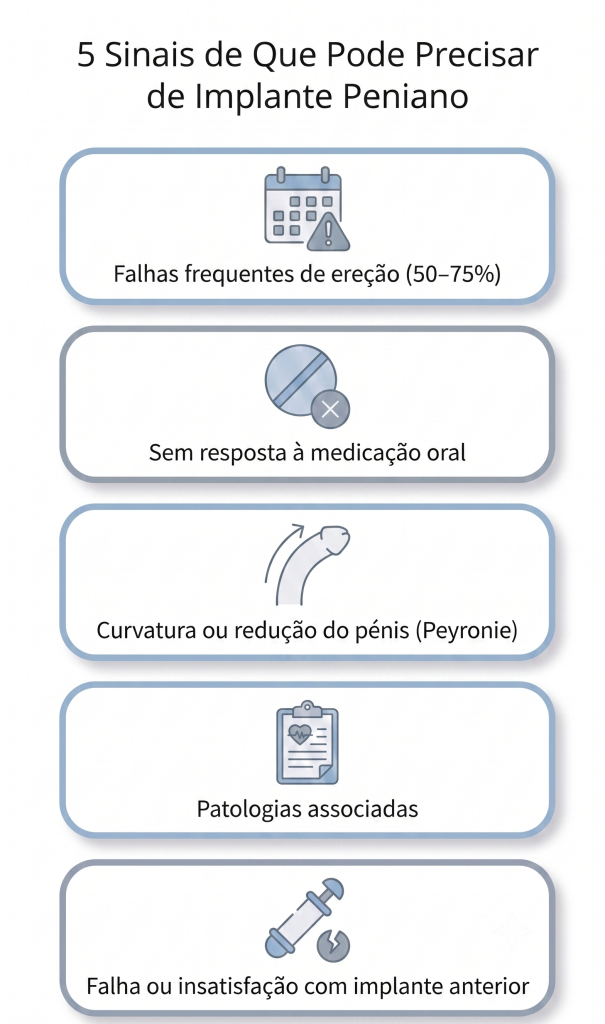
1) It is not always erectile dysfunction
Occasional situations do not necessarily indicate erectile dysfunction. After all, it is normal for a man to have occasional erection difficulties. Anxiety, stress, pressure and other factors can interfere with the response to sexual stimuli.
Erectile dysfunction deserves assessment when erection difficulties are persistent, recurrent or have an impact on sexual life and quality of life. It may appear in the following ways:
- Absence of erection even with sexual stimulation;
- Difficulty obtaining or maintaining an erection;
- Insufficient rigidity for penetration;
- Presence of penile curvature;
- Penis loses erection or slips out easily during sexual intercourse;
- Decrease in involuntary, nocturnal and morning erections.
Many cases can be treated with oral or injectable medication. Therefore, only the most severe cases are indicated for surgical treatment.
2) Diagnosis of conditions associated with erectile dysfunction
Certain health conditions may be associated with more complex cases of erectile dysfunction and, in some cases, a less satisfactory response to conservative treatments.
For this reason, men with the conditions listed below may benefit from urological evaluation to determine whether conservative treatment, surgical treatment or other approaches are appropriate for the case:
- Diabetes;
- Obesity;
- Peyronie’s disease;
- High blood pressure;
- Priapism;
- Prostate cancer;
- Reduced testosterone levels;
- Depression;
- Alcohol dependence and smoking.
3) Changes in penis size or curvature
Reduced length and curvature of the penis, caused by Peyronie’s disease, may lead to erection difficulties.
In these cases, the implant may be associated with penile reconstruction procedures planned according to the patient’s anatomy, with the aim of promoting sufficient rigidity for sexual activity, when clinically indicated.
In some cases, penile reconstruction techniques may be used to adapt the implant to the patient’s anatomy and tissue conditions, while respecting clinical criteria and applicable scientific recommendations, including documents from the American Urological Association (AUA), the Canadian Urological Association (CUA) and the European Association of Urology (EAU).
It is important to note that the main purpose of surgery is functional, aiming to enable sufficient rigidity for sexual activity, and not to guarantee an increase in penile length or girth.
4) You already understand penile implants: advantages, disadvantages, costs and other aspects
If you have already sought medical support from a urologist in Portugal and have received an indication for penile implant placement after careful assessment, it is important to look for adequate information.
Consulting reliable, evidence-based sources can be useful to complement medical guidance, provided it does not replace an individualised assessment.
These sources can help you understand the advantages, limitations and risks of the procedure, the different penile prosthesis models, the costs involved, the recovery process and the expected care after surgery.
5) You already have an implant and are not satisfied
Penile implant replacement may be necessary in some patients.
Dissatisfaction after an initial surgery may be related to different factors, including healing, positioning or stability of the implant, complications, previous expectations and individual clinical evolution.
In some cases, the previously chosen implant model may no longer correspond to the patient’s functional needs, preferences or clinical conditions over time.
This may occur when a patient with motor limitations in the hands chooses an inflatable prosthesis, which requires manual strength to activate the pump mechanism.
In addition, revision surgery may be necessary in situations of implant malfunction.
In general, inflatable implants may have a higher risk of mechanical failure and a greater need for replacement or revision when compared with a malleable prosthesis, although the choice of model should be individualised.
Mental health support may also be relevant in the process of adapting to the implant and resuming sexual life, especially when there are expectations, anxiety, relationship difficulties or persistent dissatisfaction.
Specialised medical evaluation for signs you may need a penile implant
The indication for placing a penile implant must be confirmed by a urologist after an individualised clinical assessment.
If you suspect severe erectile dysfunction or have questions about the need for implant revision or replacement, seek assessment from a qualified healthcare professional.
To clarify questions about erectile dysfunction, penile implants or revision surgery, you may request a urological evaluation and obtain information about the available contact channels.
Follow-up should be provided with respect for each patient’s confidentiality, privacy and clinical needs.
