

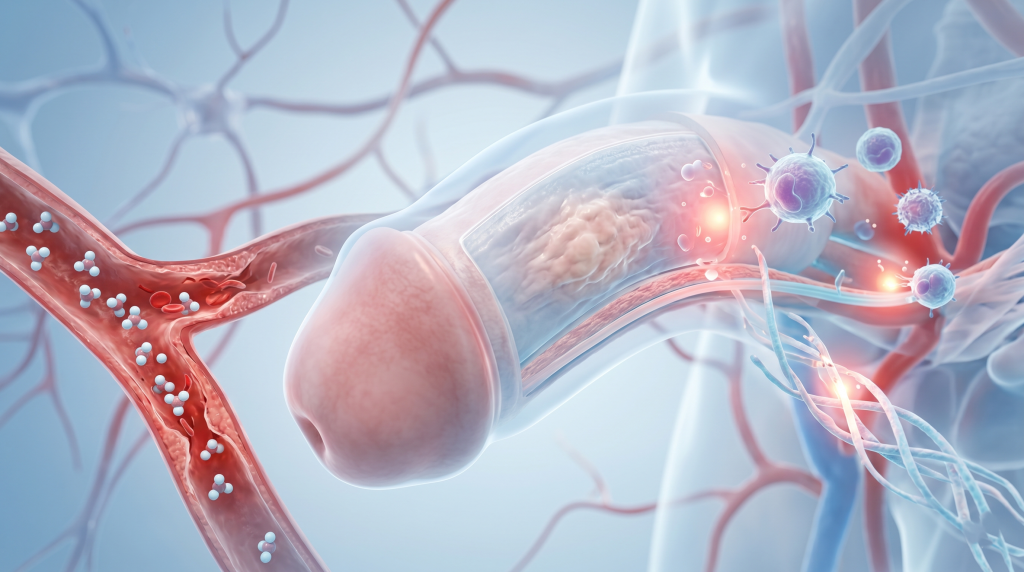
In addition to the challenges of living with a chronic or autoimmune condition, noticing changes in the penis or less rigid erections can bring new concerns.
Although it may be a difficult experience to share, it is important to seek medical evaluation when sexual health also appears to be affected. Changes in the penis can be signs of Peyronie’s Disease, a condition that can be associated with broader processes in the body, such as inflammation, blood circulation, and scarring.
What is Peyronie’s Disease?
Peyronie’s Disease is a condition in which a fibrotic area forms inside the penis. This scar can cause curvature, pain, shortening, deformity, or difficulty with sexual activity.
How penile fibrosis forms
The penis is surrounded by a structure called the tunica albuginea, which plays an important role in maintaining rigidity during erection. When this structure is injured, in some men, abnormal scarring can occur, with the formation of a hardened plaque, composed of fibrotic tissue.
How curvature develops
When there is fibrosis, the affected area loses elasticity. The result is unequal expansion of the penis during erection. This imbalance creates the curvature.
Phases of the disease
Peyronie’s Disease presents itself in two phases, which help guide treatment:
- Inflammatory phase: This is the active phase of the disease, in which an inflammatory process occurs. There may be pain during erection and progressive increase in curvature.
- Chronic phase: In this phase, fibrosis completes the scarring process and stabilizes. The penis stops undergoing changes.
The relationship between diabetes and Peyronie’s Disease
How diabetes affects blood vessels
In diabetes, especially when not well controlled, blood vessels can suffer injury. This process is called microangiopathy.
Chronic inflammation and abnormal scarring
Diabetes is also associated with low-grade chronic inflammation and increased oxidative stress. In other words, cells are exposed to a more aggressive environment, with greater tendency for damage and imperfect repair.
Link between erectile dysfunction and Peyronie’s
Microangiopathy reduces the capacity for tissue irrigation. As a consequence, the man may experience less firm erections, less lasting or more difficult to maintain.
Peyronie’s Disease and autoimmune conditions
Autoimmune diseases are conditions in which the body’s immune system attacks its own tissues. Some autoimmune conditions, such as systemic lupus erythematosus (SLE), rheumatoid arthritis (RA), and Sjögren’s syndrome, are associated with increased inflammation and altered tissue repair processes.
How autoimmune diseases affect penile health
In autoimmune conditions, chronic inflammation can affect various tissues, including those of the penis. The persistent inflammatory state can favor the formation of fibrosis and the development of Peyronie’s Disease.
Inflammation and scarring in autoimmune patients
Patients with autoimmune diseases often have higher levels of inflammatory markers in the bloodstream. This chronic inflammatory environment can impair the normal healing process and favor abnormal scarring, which may contribute to the development of penile fibrosis.
Risk factors for Peyronie’s Disease
Understanding the risk factors for Peyronie’s Disease can help identify patients at higher risk and encourage early medical evaluation. Key risk factors include:
- Diabetes: Especially when not well controlled
- Autoimmune diseases: Such as lupus, rheumatoid arthritis, and Sjögren’s syndrome
- Age: More common in middle-aged and older men
- Penile trauma: From sexual activity or injury
- Erectile dysfunction: May increase risk of penile injury
- Genetic predisposition: Family history of Peyronie’s Disease
Prevention and management strategies
For men with diabetes or autoimmune conditions, several strategies can help reduce the risk of developing Peyronie’s Disease or minimize its impact:
- Glycemic control: Maintaining good blood sugar control in diabetic patients
- Regular medical follow-up: Monitoring overall health and sexual function
- Healthy lifestyle: Exercise, balanced diet, and stress management
- Sexual health awareness: Recognizing early signs of penile changes
- Prompt medical evaluation: Seeking specialist care if changes are noticed
If you have questions about Peyronie’s Disease, diabetes, autoimmune conditions, or need specialized guidance, contact us for a personalized consultation.