


There are different surgical approaches to treat penile curvature, including techniques that shorten the longer side and techniques that expand the shorter side. The choice depends on the clinical and anatomical characteristics of each case.
In cases where penile curvature has a surgical indication, it is necessary to assess during consultation which approach is the most appropriate. Among the possible techniques, Nesbit plication and the geometric technique described by Egydio may be considered, among other options, according to the clinical situation.
Although both techniques aim to correct penile curvature, they are distinct surgical approaches based on different technical principles. One works by shortening the longer side, while the other seeks to correct the deformity by expanding the shortened side.
Both techniques may be used in selected cases of penile curvature, although they differ in terms of their objectives, limitations, and possible implications for aspects such as alignment, penile length, comfort, and perception of the outcome.
Below is a general explanation of these approaches, with technical and clinical context.
What is Nesbit plication and how does it work?
Nesbit plication is a surgery introduced in 1965 that corrects penile curvature by shortening the longer side of the penis through sutures placed in the tunica albuginea (plications).
The technique is mainly indicated for men with good erectile function, no significant loss of penile length, and simple curvatures.
Because it is a shortening technique, Nesbit surgery may be associated with a decrease in penile length, an aspect that should be discussed with the patient beforehand in the context of therapeutic decision-making.
The mechanism: shortening to straighten
In the Nesbit technique, the surgeon equalizes both sides of the penis by shortening the side opposite the curvature, that is, the longer side. This is done through plications, which are folds in the tunica albuginea. These folds are secured with sutures.
This approach seeks to improve penile alignment by shortening the longer side and may be associated with reduced penile length.
In which cases is it indicated?
Plication is one of the earliest techniques used to treat penile curvature and is therefore a more traditional procedure, indicated for less complex cases.
The technique may be an appropriate option for simple cases when there is:
- Isolated curvature;
- Curvature in a single plane;
- An erection rigid enough for sexual intercourse;
- Adequate penile length to avoid excessive shortening.
Recognized advantages of Nesbit plication
Plication is a less complex technique from a reconstructive point of view. In general terms, it may be associated with less manipulation of some anatomical structures, although the risks and limitations must be assessed individually in each case.
Limitations the patient should know about
One of the main limitations of plication is the possibility of penile shortening. For this reason, its indication should be carefully weighed when there is already significant loss of length.
In addition, the technique may show limitations in more complex cases, such as those involving volume loss, indentations, or hourglass deformities.
What is the Egydio Technique and how does it work?
The technique described by Egydio is a surgical approach used in the correction of penile curvature by expanding the shortened side through planned incisions in the tunica albuginea. In certain cases, it may also be considered in the presence of caliber changes.
This technique is a reconstructive strategy and is indicated in men with more complex curvatures, associated deformities such as narrowing, hourglass deformity, or multiplanar curvature, and also in cases where preserving penile length is a priority.
The mechanism: expanding to straighten
The Egydio Technique is based on a technical principle different from Nesbit plication. Instead of shortening the longer side, it acts on the retracted area responsible for the deformity.
For this purpose, planned incisions are made in the tunica albuginea with the aim of expanding the retracted segment and allowing correction of the deformity, including, in certain cases, areas of narrowing.
The entire procedure is performed without the need for grafts or permanent sutures.
The geometric principle behind the technique
The main difference between the Egydio Technique and Nesbit plication is the geometric calculation. The technique identifies the point of maximum penile curvature and, from the bisector, precisely defines where, how many, and how extensive the incisions should be.
The planned incisions aim to allow expansion of the retracted segment while seeking to preserve the functional integrity of the tunica albuginea. In situations involving associated erectile dysfunction and an indication for penile prosthesis, this approach may also be incorporated into the reconstructive planning of the case.
In which cases is it indicated?
The technique described by Egydio may be considered in different clinical contexts of penile curvature, according to case assessment, namely when there is:
- Curvature in multiple planes;
- Significant loss of length or a naturally shorter penis;
- Hourglass narrowing or indentations;
- Associated erectile dysfunction;
- Need for penile prosthesis.
Direct comparison: Egydio Technique vs Nesbit Plication
Although both are intended to correct penile curvature, the Egydio Technique and Nesbit plication are based on different surgical approaches and lead to different outcomes.
Comparing these approaches may help clarify some relevant technical and clinical differences:
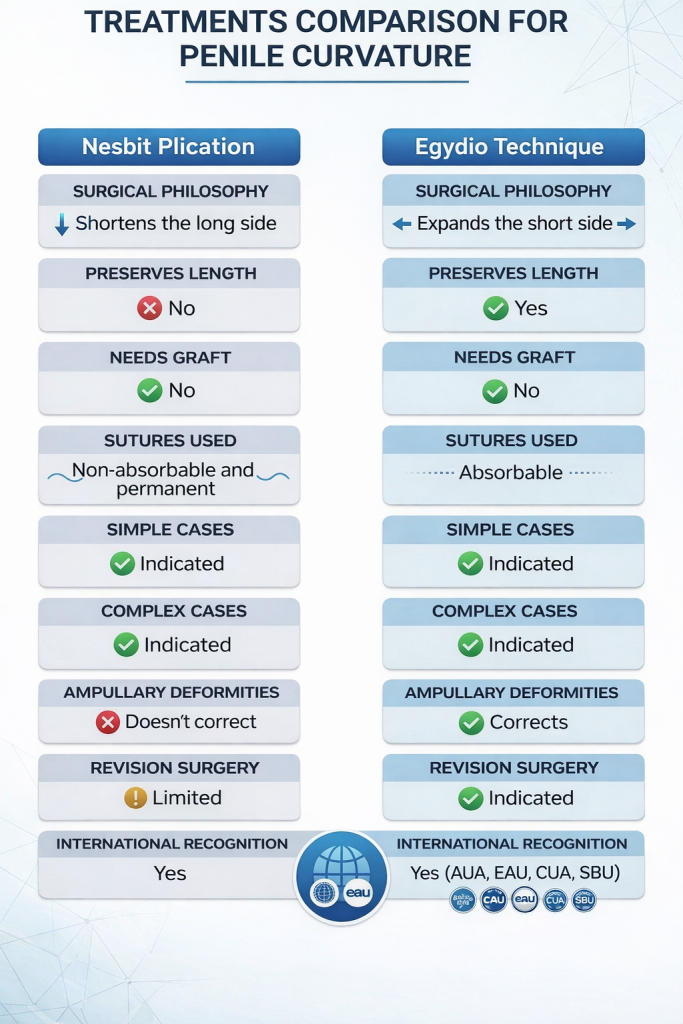
Preservation of penile length
For many men, preserving penile length is one of the most important aspects in the surgical decision. Loss of length may affect self-confidence, body image, and sexual life.
In the technique described by Egydio, the intervention focuses on the shortened side, seeking to expand it. In certain cases, this approach may favor preservation of penile length within the anatomical limits of each patient.
In Nesbit plication, correction is obtained by shortening the longer side, so a reduction in penile length may occur.
Complexity of the cases treated
If the penis, in addition to being curved, shows narrowing, it may lose stability, diameter, and symmetry.
Plication may have limitations in this type of deformity because it is primarily focused on alignment. In some cases, the geometric expansion approach may be considered in the presence of narrowing, indentations, or hourglass deformities.
Sutures and materials used: a detail that matters
In plication techniques, permanent sutures are used in the tunica albuginea, and they may remain palpable under the skin and cause discomfort or pain on touch. These sutures are used to keep the tissue fold stable over time.
In the approach described by Egydio, absorbable sutures may be used depending on the technique adopted. This aspect may be relevant to the postoperative experience of some patients, including local comfort.
Do you have questions about which technique may apply to your case? Dr. Paulo Egydio offers a case pre-assessment. Contact the clinic.
When Nesbit plication may still be a good option
Nesbit plication should not be ruled out. In well-selected cases, it may still be a good option, provided that the indication results from a urologist’s evaluation according to the particularities of each case.
Ideal profile for plication
Nesbit plication may be considered in patients with simple curvature, sufficient penile length, preserved erectile function, and absence of associated deformities. In these contexts, it may represent a less complex approach from a technical point of view.
The role of the surgeon in choosing the technique
The decision must be made based on a rigorous and individualized assessment of each case, taking into account the degree of deformity, erectile function impairment, penile length loss, and the impact of the condition on intimate life.
It is the surgeon’s role to weigh the advantages and limitations of each strategy and propose the approach best suited to the patient’s anatomy, clinical needs, and expectations.
What happens when plication is not enough
Nesbit plication may not be sufficient for two main reasons: either because the deformity is more complex than the technique can correct, or because, over time, the sutures may loosen, detach, or no longer support the correction.
When this happens, the patient may be left with incomplete straightening, recurrence of curvature, a sensation of excessive shortening, or discomfort from palpable sutures and nodules. In other words, even when there is initial improvement, the result may not remain satisfactory in the long term.
In these cases, urological reassessment is important. Depending on the clinical situation, revision surgery with a reconstructive approach may be necessary, and the technique described by Egydio may be considered among other options.
Have you already had surgery and are not satisfied with the result? The Egydio Technique may be used as revision surgery. Start your case pre-assessment.
The international recognition of the Egydio Technique
The technique described by Egydio was developed in the academic and surgical context of Peyronie’s disease correction and has also been disseminated in the literature and in international scientific settings.
Reference in urological literature and scientific documents
The geometric technique is cited in the literature and in reference documents used by major medical societies such as the EAU (European Association of Urology), AUA (American Urological Association), and CUA (Canadian Urological Association).
This is a technique described in scientific publications and discussed in the urological context, and its application should always be framed by the clinical criteria of each case.
Accumulated experience: more than 7,000 surgeries
Over the years, this technique has been used in a high number of procedures, information that may help contextualize the accumulated experience in its clinical application.
Publications and international congresses
The Egydio Technique is present in 475 national and international publications in the urological literature. Among them, the paper published in the Journal of Sexual Medicine in 2020 on the strategy of tunica albuginea tissue expansion without grafting stands out.
In addition, Dr. Paulo Egydio is invited to urology congresses and courses around the world, which reflects the relevance of his experience and the recognition of the technique among peers.
Shorten or expand: your choice defines the result
In practice, the choice of surgery for penile curvature should not be reduced to an opposition between techniques. This decision depends on the clinical characteristics of the case and the patient’s expectations.
When the deformity is limited, plication may be an option to consider. When there are more complex deformities, such as shortening, hourglass deformity, narrowing, multiplanar curvature, or relevant surgical history, it may be necessary to consider more differentiated reconstructive approaches.
If you have read this far, you already know that the choice of technique matters as much as the decision to operate. The next step is to understand which one applies to your case. Start your Case Analysis now free of charge, confidential, and tailored to your clinical history.
